
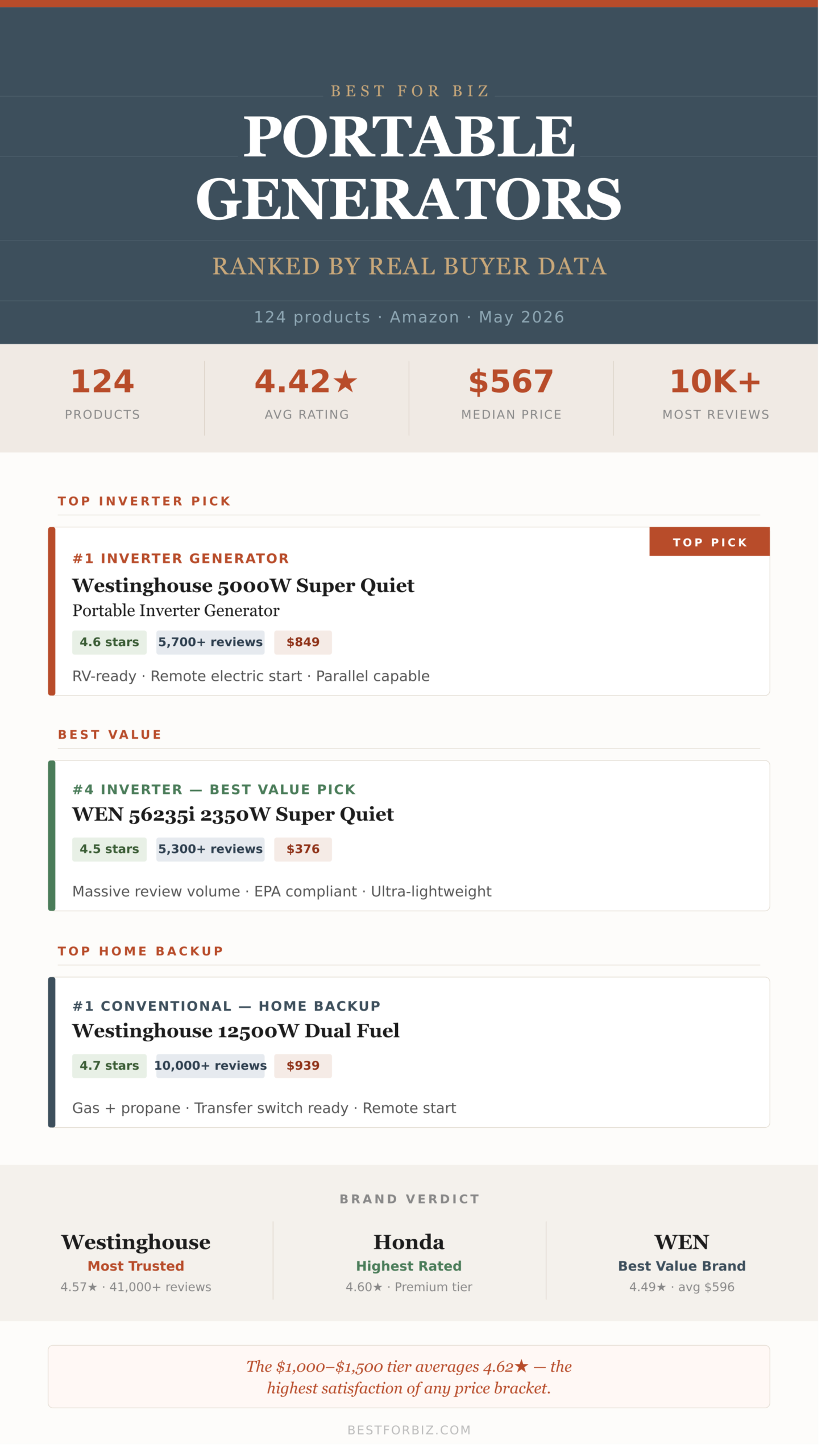
The portable generator market on Amazon is large, crowded, and somewhat confusing. Inverter generators and conventional portables share the same search results, battery-powered “solar generators” show up alongside gas models, and sponsored placements push brand-name products to the top regardless of actual performance. We cut through the noise by pulling 150 listings and analyzing the 124 gas-powered generators with full rating and review data, scoring each on a combined metric that weighs star rating and review volume.
The short version: Westinghouse and Honda dominate on ratings, WEN delivers the best value in the inverter category, and the $1,000–$1,500 price tier outperforms every other bracket on average satisfaction. Whether you need a quiet inverter unit for camping and RV travel or a high-wattage conventional generator for home backup and job sites, the data points to a clear set of leaders.
How the Portable Generator Market Actually Breaks Down
Amazon’s generator search results are a study in category sprawl. Of the 150 listings we captured, 26 were battery-powered portable power stations (brands like Jackery, EcoFlow, Bluetti, and Anker) that showed up because they use “generator” in their titles or descriptions. These are useful products, but they serve a different buyer than someone looking for a gas-powered unit. We excluded them from all rankings and charts here.
Of the 124 gas-powered generators, 102 are inverter models and 22 are conventional open-frame designs. That 82/18 split tells you something important about where the market has moved: inverter technology has largely taken over the portable segment because buyers increasingly prioritize quiet operation and fuel efficiency over raw wattage. The conventional segment is smaller but still commands a healthy share among buyers who need serious home-backup capacity and aren’t worried about noise.
N=117 gas generators with rating data. Battery power stations excluded from this chart.
The rating curve is sharply left-skewed in the good direction. Over 70% of gas generators in the dataset carry a 4.3-star rating or better, and only 9 products sit below 4.0. That 4.5-star peak isn’t a coincidence: it’s roughly where the major brands (WEN, Westinghouse, Champion, Honda) cluster their mainstream lineups. Anything at 4.6 or above represents a product that has genuinely earned customer loyalty rather than just avoiding complaints.
The seven perfect 5.0-star products deserve a footnote. Most are newer listings with under 100 reviews, which inflates the rating. A product with 20 five-star reviews is probably fine; it’s not the same as a 4.8-star model backed by 2,000 reviews. Our ranking model accounts for this by weighting review volume alongside raw rating, which is why some of these five-star newcomers don’t crack the top picks.
Does Spending More Get You a Better Portable Generator?
The honest answer is: mostly yes, up to a point. The data shows a clear upward trend in average satisfaction from the entry-level tier through the $1,000–$1,500 range, at which point the line plateaus and actually dips slightly for the $1,500-and-up bracket. That dip is likely explained by the composition of the top tier: it includes some commercial-grade and industrial units with narrower, more demanding audiences who hold products to a higher standard.
Based on 117 gas generators with complete rating data. Chart baseline set at 4.0 to show meaningful differentiation.
The $400–$700 range deserves special attention as a value tier. It’s densely populated with well-reviewed inverter generators from WEN, Westinghouse, and Champion, and the average 4.41-star rating is only modestly below what the $700–$1,000 tier delivers. For buyers who don’t need the power output of a mid-range home backup unit, this is where the spending efficiency peaks.
The entry-level under-$400 bracket lags visibly at 4.28 stars. That’s still a respectable market average, but the spread within this tier is wider, meaning more lemons mixed in with the solid budget picks. If you’re buying in this range, review count becomes a critical filter. A sub-$400 generator with 2,000+ reviews at 4.4 stars is a very different proposition than an unproven listing at $299.
Inverter vs. Conventional: What the Market Split Looks Like
Amazon’s generator search results are an 82% inverter market by listing count. That doesn’t mean conventional generators are obsolete. It means buyers searching “portable generator” on Amazon are mostly looking for camping, RV, and light home-backup power, not 12,500-watt whole-house backup. The conventional segment that remains is high-wattage, dual-fuel or tri-fuel, and generally aimed at serious home preparedness. These are different products serving different needs, and they rank on different criteria.
N=150 total listings captured from Amazon search. Battery power stations were identified by product type and excluded from gas generator rankings and charts.
If you’re replacing a failed generator or buying your first one, the type decision shapes everything else. Inverter generators use variable-speed engines that adjust to load, making them significantly quieter (typically 50–60 dB vs. 65–75 dB for conventional), more fuel-efficient, and safe for sensitive electronics like laptops and medical equipment. They tend to top out around 4,000–7,000 watts in the portable segment. Conventional generators run at a fixed RPM, are louder, less fuel-efficient, but capable of much higher wattage output and are considerably cheaper per watt at the high-capacity end.
For most small-business buyers, the inverter category is the right starting point. A 3,600–5,000 watt inverter unit covers outdoor events, food trucks, job site tools, and short-term power outages without the noise or emissions profile of a conventional open-frame unit. The conventional segment makes more sense for contractors running heavy equipment, or for home owners who want to power their HVAC, sump pump, and refrigerators simultaneously during an extended outage.
Top-Ranked Portable Generators: Our Data-Driven Picks
Rankings combine star rating (60% weight) with log-scaled review volume (40% weight). Only organic listings are included. Products were ranked independently within each sub-type so inverter and conventional buyers get a relevant list for their use case.
Inverter Generators
Conventional & Home Backup Generators
Brand Comparison: Who Makes the Most Reliable Portable Generators?
Thirteen brands appear with two or more products in our analyzed dataset. The spread in ratings and review volumes tells a story that goes beyond individual model performance, and it’s worth understanding before you commit to a brand ecosystem for service, parts, and future purchases.
| Brand | Products | Avg Rating | Total Reviews | Avg Price | Take |
|---|---|---|---|---|---|
| Westinghouse | 16 | ★ 4.57 | 41,000+ | $965 | Dominant brand. Strongest review volume by far; leads both inverter and conventional sub-types. |
| Honda | 15 | ★ 4.60 | 5,400+ | $1,680 | Highest average rating. Premium pricing reflects genuine build quality and legendary reliability. |
| WEN | 14 | ★ 4.49 | 22,400+ | $596 | Best value brand. Covers budget to mid-range with solid ratings and very high review counts. |
| PowerSmart | 12 | ★ 4.48 | 3,200+ | $393 | Entry-level focus. Consistent ratings in the $300–$500 range; review volume still building. |
| Champion | 11 | ★ 4.42 | 1,800+ | $939 | Solid mid-tier brand. Lower review density per model than Westinghouse at similar price points. |
| Pulsar | 9 | ★ 4.12 | 4,000+ | $443 | Budget-friendly but lagging. Lowest average rating among multi-product brands; worth scrutinizing individual models before buying. |
| Oxseryn | 4 | ★ 4.70 | 1,000+ | $300 | Impressive rating at a low price, but newer brand with limited review depth. Monitor before committing. |
| A-iPower | 4 | ★ 4.32 | 2,500+ | $752 | Mid-market alternative to the major brands; adequate ratings without a standout track record. |
| AMERISUN | 3 | ★ 4.57 | 355+ | $490 | Strong early ratings but very thin review base. Encouraging, not yet proven. |
| GENMAX | 3 | ★ 3.83 | 148+ | $817 | Lowest average rating and very few reviews for the price asked. Avoid until more data accumulates. |
| Generac | 3 | ★ 4.27 | 136+ | $756 | Generac is best known for standby units; its portable lineup underperforms rivals at similar prices. |
| ERAYAK | 2 | ★ 4.30 | 1,000+ | $419 | Adequate budget option with modest review depth; not a first-pick but acceptable for price-sensitive buyers. |
| Cummins | 2 | ★ 4.45 | 178+ | $1,097 | Commercial-grade brand with solid ratings and very limited Amazon review history in the portable segment. |
Three brand stories stand out. Westinghouse‘s dominance is genuinely earned: 41,000+ cumulative reviews at a 4.57 average across 16 products is the kind of market signal that can’t be manufactured. The brand has cracked the code on the Amazon portable generator buyer, and the data validates the product quality behind the marketing. Honda runs a tighter operation: 15 products, far fewer total reviews, but the highest average rating in the dataset at 4.60 stars and an average price of $1,680. Honda buyers are paying for a known quantity, and the reviews confirm they get it.
Pulsar is the brand to watch with skepticism. A 4.12 average rating across nine products isn’t disqualifying, but it’s the weakest showing among established multi-model brands, and it sits in the $300–$500 price range where competitors like WEN and PowerSmart post significantly higher scores for comparable prices. Individual Pulsar models may be fine, but there’s no brand-level track record here that argues for defaulting to it over alternatives.
Oxseryn is the wildcard. Four products averaging 4.70 stars at a $300 average price sounds too good. It might be. The review base (around 1,000 total across four products) is thin enough that the rating hasn’t been stress-tested by a large and diverse buyer pool. Worth watching, but not yet in the same confidence tier as WEN or Westinghouse for a first-time buyer who can’t tolerate uncertainty.
How to Choose the Right Portable Generator for Your Situation
The data narrows the field considerably, but the final decision still depends on your specific load requirements, use environment, and budget constraints. These are the questions that actually determine the right pick.
Add up the running wattage of everything you’d run simultaneously, then multiply by 1.25 to get a comfortable rated-watt target. A refrigerator (200W), window AC (1,400W), and a few lights and phone chargers puts you around 2,000W running. Most 3,600-watt inverter generators handle that easily. Running a central AC unit, well pump, or multiple high-draw appliances simultaneously pushes you into the 8,000–12,500 watt conventional range.
Inverter generators typically run at 50–60 dB, roughly equivalent to a normal conversation. Conventional open-frame generators run at 65–75 dB, closer to a lawnmower. For campgrounds with noise rules, neighborhood use during outages, or events near customers, the inverter’s quieter operation isn’t optional. For a job site or rural property, the noise difference matters less than wattage output and fuel cost.
Inverter generators produce “clean” power (low total harmonic distortion, typically under 3%), which is safe for computers, phones, and medical equipment. Conventional generators produce “dirtier” power that can damage sensitive devices over time. If you’re powering anything beyond basic appliances and power tools, choose an inverter model.
Inverter generators are significantly more fuel-efficient than conventional models, often running 7–10 hours on a single gallon at partial load. If you’re buying for extended outages or remote locations where fuel resupply is difficult, that efficiency compounds quickly. Dual-fuel models (gas + propane) add flexibility during an emergency when gas stations may be out of fuel, which is exactly when you need the generator most.
The California Air Resources Board restricts generator sales to CARB-compliant models. Many conventional generators can’t be sold or shipped to California, Colorado, and other states that have adopted CARB standards. If you’re in one of these states, filter for CARB compliance before shortlisting any model. Most major inverter generators are CARB compliant; the Westinghouse EFI model in the conventional category is explicitly noted for it.
The Verdict
The portable generator market has a clear winner brand (Westinghouse), a clear prestige brand (Honda), and a clear value brand (WEN). Between the three of them, they cover 45 products in our dataset with consistently strong ratings and the review depth to back them up. If you’re buying a portable generator for the first time and don’t have a strong reason to go elsewhere, these three brands are where you should start your search.
The inverter vs. conventional question is less about budget than it is about use case. Inverter technology has matured to the point where the price premium over conventional is modest in the sub-$1,000 range, and the noise, fuel efficiency, and clean-power benefits are real. Unless you specifically need 8,000+ watts for whole-home backup, the inverter market is where the best value currently lives.
Related business guides: server racks on amazon guide and wifi range extenders for the office guide for more practical business equipment advice.