

If you handle cash, choosing the right money counting machine can save you time, cut errors, and protect your business from fake bills. You want a device that counts quickly, handles mixed denominations when needed, and includes reliable counterfeit detection so deposits and daily reconciliations are accurate and secure.
Top Picks
|
Category |
Product |
Score |
|---|---|---|
|
💰 Best Budget Value |
90/100 |
|
|
🎯 Best for Mixed Currencies |
86/100 |
|
|
⭐ Best for Retail |
83/100 |
|
|
🔰 Best for Updates & Support |
85/100 |
|
|
🚀 Best for Sorting |
86/100 |
|
|
🏅 Best Professional-Grade |
88/100 |
|
|
🔒 Best for Accuracy |
80/100 |
|
|
💼 Best for Large Operations |
87/100 |
How We Selected
We focused on the features that matter when you run a cash business: counting accuracy, speed, and the quality of counterfeit detection (UV, MG, IR, DD and advanced sensors). You should also consider mixed-denomination value counting, build quality and weight for durability, helpful displays or external customer screens, maintenance and firmware support, and overall value given your daily volume. Scores reflect hands-on capability reported by users, detection methods included, manufacturer support, and price positioning so you can match a model to your needs quickly.
💰 Best Budget Value

LOLARAN AL1000
This is the kind of counter you reach for when you want speed without fuss. You load a messy stack, hit start and the AL1000 chews through bills quickly while checking for common counterfeits. It handles mixed orientations, has handy batch and add modes for reconciling tills, and a clear LCD so you can see counts at a glance. It’s built heavier than it looks, so it feels stable on a countertop, and the carry handle and included accessories make it practical for moving between registers or counting stations.
If your priority is reliable, straightforward counting with basic multi-method detection, this is an easy everyday tool to keep on hand.
What People Say
Customers often highlight how quickly the machine counts and how solid it feels for the price. People like the add and batch features for making deposits, and many appreciate that bills can be mixed face-up or face-down.
A few mention occasional jams if you overload the hopper, but most say breaking stacks into smaller loads solves the issue.
Overall Sentiment: Positive

Versatility
This model works well for everyday retail, small restaurants, charity events and pop-up sales where you need fast, accurate counts and basic counterfeit checks. You can switch between dollar and euro modes, use value counting for denomination batches, and move the unit between stations thanks to the carry handle.
It won’t replace bank-grade mixed-denomination value sorting, but it covers common business scenarios reliably.
Practicality
Setup is straightforward so you can hand it to a colleague and get counting right away. The LCD is readable from across a counter and the physical controls focus on the essentials, which keeps training time low. For daily use, keep stacks modest to avoid jams, use the batch feature to create bank-ready bundles, and run suspect bills through the reject routine when a detection flag appears.
Key Benefits
- Fast counting up to 1,000 notes per minute to cut end-of-day time
- Multiple counterfeit checks (UV, MG, MT, IR, DD) for basic fraud protection
- Batch and add modes let you build deposit-ready stacks and running totals
- Handles mixed orientations so you don’t spend extra time sorting
🎯 Best for Mixed Currencies
Aneken Mixed
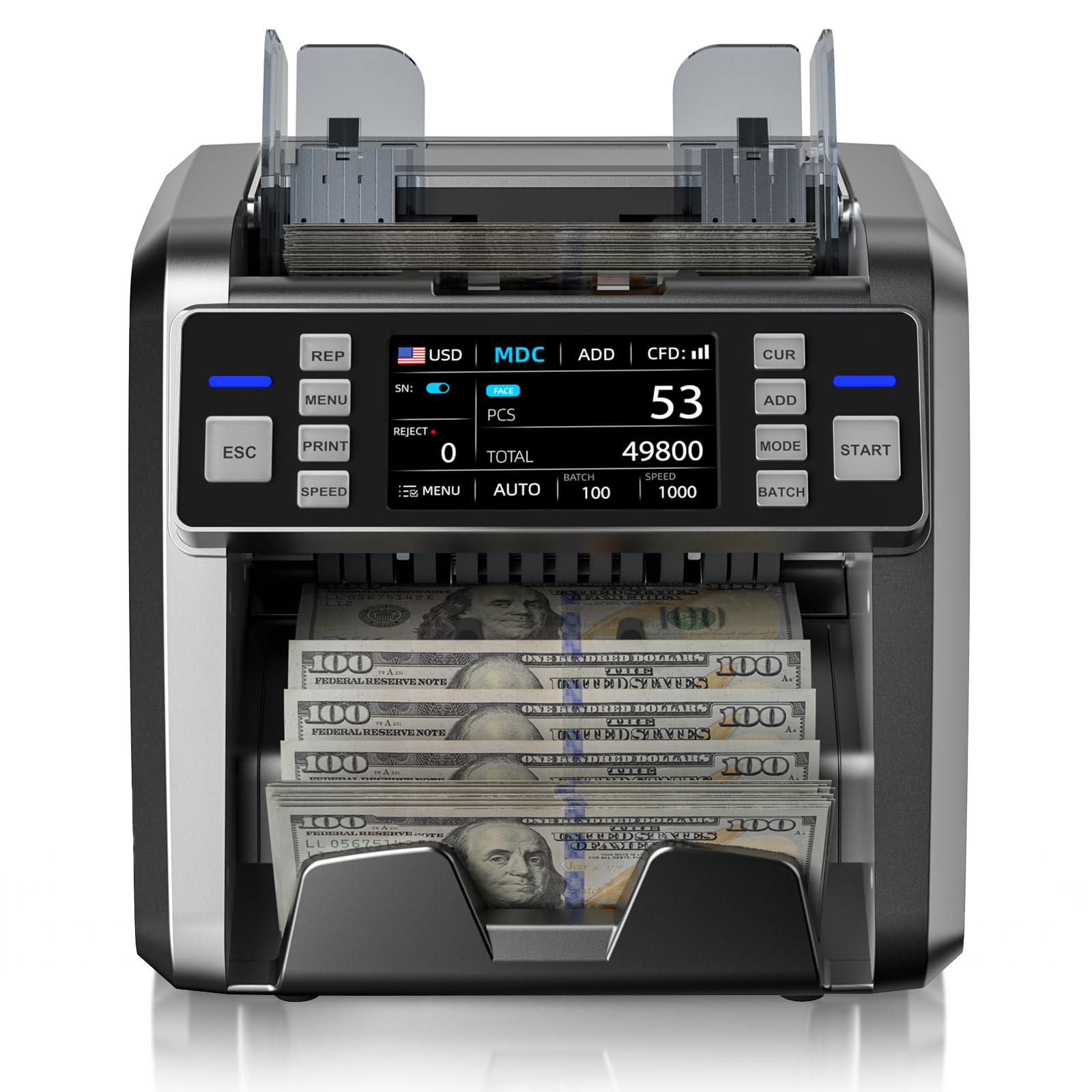
If you handle varied currencies or messy stacks, this machine makes daily counting feel easier. You drop mixed bills in and it identifies denominations, totals values, and flags suspect notes using dual sensors and multiple detection methods. The touchscreen and physical buttons give you flexible control, and features like serial number recognition and batch options mean you can reconcile tills or prepare deposits faster.
It’s a heavier, pro-style unit that fits well in busy registers, currency exchange counters, or any place where different currencies or mixed stacks are common.
What People Say
Buyers commonly praise the machine’s ability to handle mixed stacks and different currencies without pre-sorting, and they appreciate the advanced detection methods for extra confidence. Users note the clear touchscreen and useful batch/add features, while occasional issues reported relate to power or start-up quirks and jams typically caused by overfilled or poorly aligned stacks.
Overall Sentiment: Positive

Versatility
This is a smart choice if you work in tourism-heavy locations, exchange desks, car dealerships or busy restaurants where bills from multiple countries or mixed denominations arrive together. You can run single-currency high-speed counts or use mixed modes when needed, making it useful for both daily shifts and special cash-heavy events.
Practicality
Set-up is straightforward and the combo of touch and physical controls keeps training short. For best results, square your stacks and consider manual start if auto mode misfires; the unit ships with cleaning and calibration accessories and supports firmware updates so it stays useful as new notes appear.
Key Benefits
- Counts mixed denominations and returns total value automatically
- Supports many currencies with advanced 2CIS imaging and multi-method detection
- Touchscreen plus physical buttons for intuitive control and quick adjustments
- Batch, add and serial-number features streamline deposits and audits
⭐ Best for Retail
LOLARAN N71
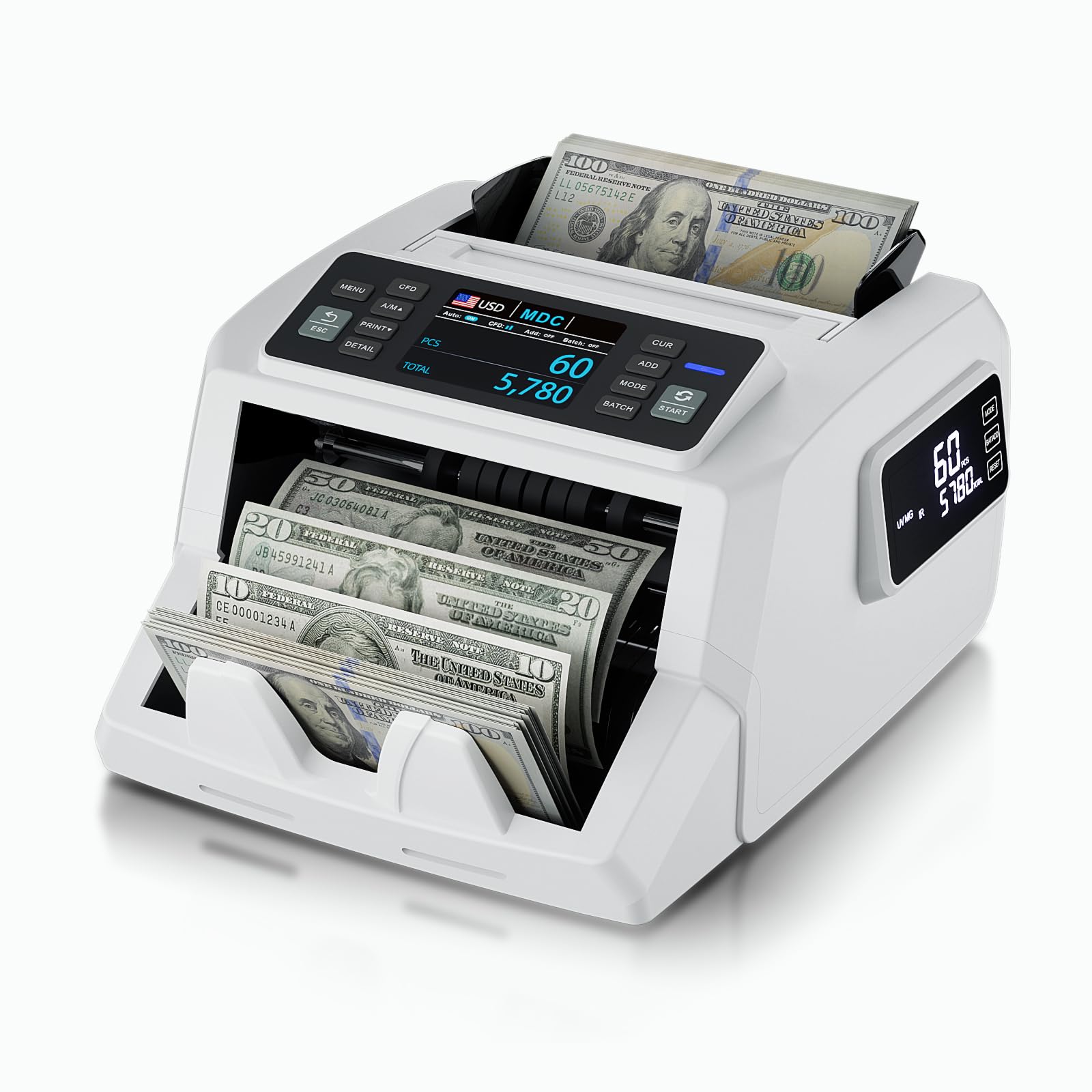
You drop mixed bills in and the N71 reads denominations, tallies totals and highlights suspect notes so you don’t have to sort every stack by hand. The dual displays let both you and a customer or colleague watch the count, and the batch/add features make preparing deposits straightforward. It’s a compact, fairly quiet unit that fits on a counter but still feels solid, and the combination of touch and physical controls keeps everyday use simple.
For busy shifts, fairs or weekly reconciliations, this model cuts the manual work and gives you faster, more confident cash handling.
What People Say
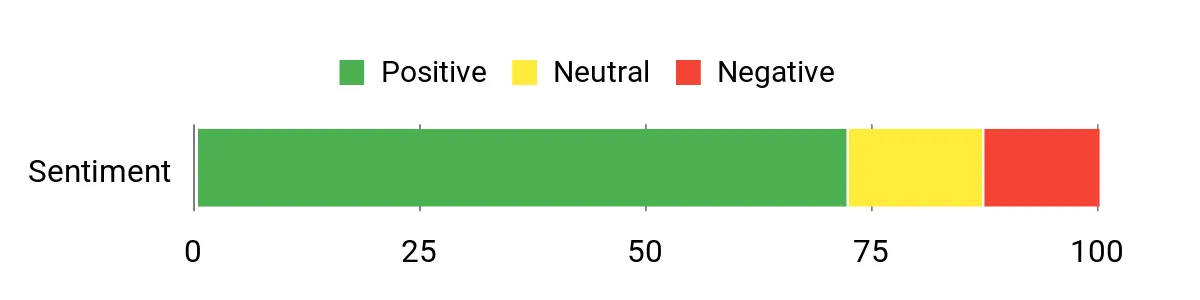
Users frequently note that the N71 saves time because it reads mixed stacks and gives a denomination breakdown, which is especially handy at busy registers. Many appreciate the dual-display setup and straightforward controls, while occasional comments point to setup quirks or jams when stacks are overfilled, with simple fixes like adjusting the feed gap or using manual start resolving most issues.
Overall Sentiment: Positive
Versatility
This unit works well for small to mid-size retailers, event booths, fundraisers and restaurants where mixed bills arrive together. You can switch currency modes for USD, EUR, MXN, GBP or CAD and use batch settings for bank-ready bundles, making it useful for both daily shifts and periodic high-volume counts.
Practicality
Setup is relatively quick and the included maintenance items help keep it reliable; teach staff to square stacks and avoid overloading the hopper to minimize jams. If auto start is finicky, use manual mode for controlled feeds, and consider adding an external printer later if you want a printed audit trail.
Key Benefits
- Counts mixed denominations and provides a total value automatically
- Dual displays increase transparency for staff and customers
- Multiple counterfeit checks (UV, MG, IR, DD) add fraud protection
- Batch and add modes speed deposit prep and shift reconciliations
🔰 Best for Updates & Support

MUNBYN IMC01
You get a heavier, professional unit designed for reliable mixed-denomination counting and thorough counterfeit checks. The IMC01 reads bills, logs serial numbers and connects to a printer for audit trails, while firmware updates let it learn new currencies as they appear.
It’s the kind of machine you bring out for daily till closes, large deposits, or any time you want a dependable second pair of eyes on cash handling.
What People Say
Users commonly praise the IMC01 for its dependable mixed-currency handling and strong detection suite, and many note the company’s willingness to provide firmware updates for additional currencies. Customers also appreciate the printer and serial-number features for recordkeeping, while occasional issues reported tend to involve setup quirks or rare hardware faults addressed through support.
Overall Sentiment: Positive

Versatility
This machine fits banks, currency exchange desks, large retailers and businesses that process mixed stacks or need serial-number records. It works well for daily shift counts, weekend events with heavy cash, and reconciliation tasks that benefit from a printed audit trail.
Practicality
Expect a straightforward setup but plan a short learning curve for advanced features like serial logging and printer integration. Regular cleaning and following feed guidelines cut down on jams, and the availability of firmware updates and responsive support makes upkeep easier over time.
Key Benefits
- Bank-grade mixed-denomination accuracy for faster reconciliations
- Advanced 2CIS + multi-method detection reduces counterfeit risk
- Serial-number logging and printer compatibility for audits
- Firmware and support options that add new currencies and fixes
🚀 Best for Sorting

Kolibri KBR-1500
You’ll notice this unit if sorting and denomination organization is a daily headache. The KBR-1500 sorts, orients and counts mixed stacks while checking for fakes, and it can print a tally so you have a paper trail.
It’s designed for steady professional use: plenty of sensors, a sensible hopper capacity and modes to tune speed versus accuracy. If you need organized stacks for deposits or want to hand customers a printed count, this model is built around that workflow.
What People Say
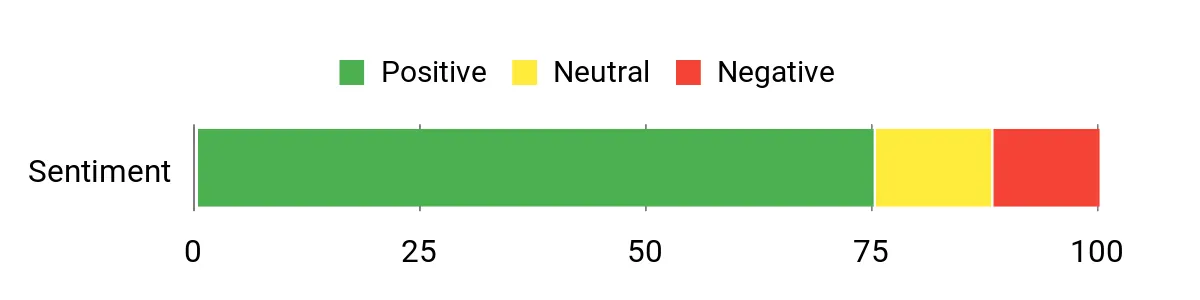
People often praise how well it separates denominations and handles random orientations, which saves time during busy shifts. Users also value the detection and reject features that keep suspect notes out of counted piles, and the printer option is a common plus for recordkeeping.
A few comments mention that higher speeds can reduce accuracy and that the display or UI could be cleaner, but most say the sorting capabilities are a major time saver.
Overall Sentiment: Positive
Versatility
This machine fits retail backrooms, cash centers, and any place where you need to turn messy cash into bank-ready bundles. Use sorting and batch modes for deposits, switch to a slower speed for delicate runs, or add the printer when you want printed records for audits or customers.
Practicality
Setup is straightforward but plan a quick run-through with staff so everyone knows when to use manual start or slower modes to avoid false rejects. Regular cleaning of sensors and following recommended stack sizes will minimize jams and keep counts consistent.
Key Benefits
- Powerful sorting and orientation for clean denomination stacks
- Robust counterfeit detection that errs on the side of caution
- Built-in printer support for receipts and audit trails
- Multiple speed settings so you can prioritize accuracy or throughput
🏅 Best Professional-Grade

Cassida 8800R
You’ll find the 8800R useful when accuracy and audit trails matter. It combines fast, bank-style counting with dual detection methods to flag suspect notes, and the external display plus printing option makes handoffs to staff or bank deposits simpler.
The unit is compact for its class and built for steady, repeated use, so it suits back-office reconciliations, tills at busy locations, and any situation where you want a reliable, professional tool for cash handling.
What People Say
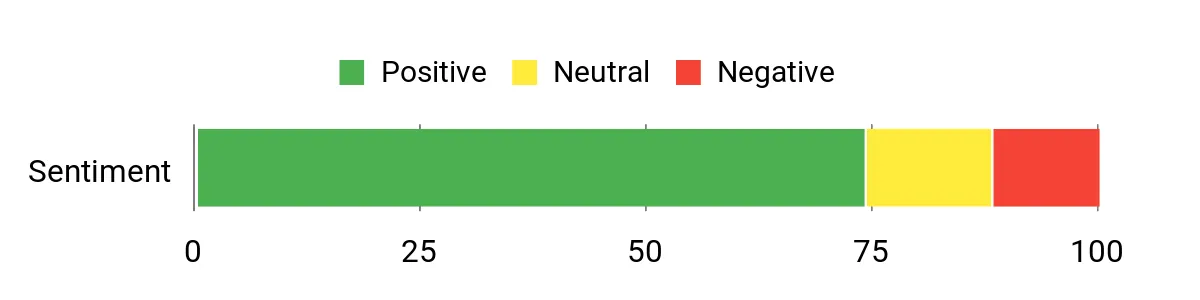
Users commonly praise its reliable counting and the peace of mind from dual detection methods, and many appreciate the external display and print capability for clear records. People also note that it handles heavy daily use well, though some call out occasional false alerts or the need to load bills neatly to avoid jams.
Overall Sentiment: Positive
Versatility
This model fits banks, retail back offices, and any business that needs printed audit trails or frequent, repeatable counts. Use it for end-of-shift reconciliations, deposit prep, or anywhere a compact, professional counter is preferred over a basic countertop unit.
Practicality
Setup is straightforward and it works well with regular maintenance; teach your team to square stacks and keep sensors clean to reduce false rejects. If you need printed proof for deposits or client transparency, enable the printer output and hook up the external display so counts are visible from both sides of the counter.
Key Benefits
- Bank-grade detection with UV and magnetic checks for better counterfeit catching
- External display and printing support for transparent counts and records
- Fast, steady counting suited to daily reconciliations and back-office work
- Compact, durable build designed for frequent professional use
🔒 Best for Accuracy
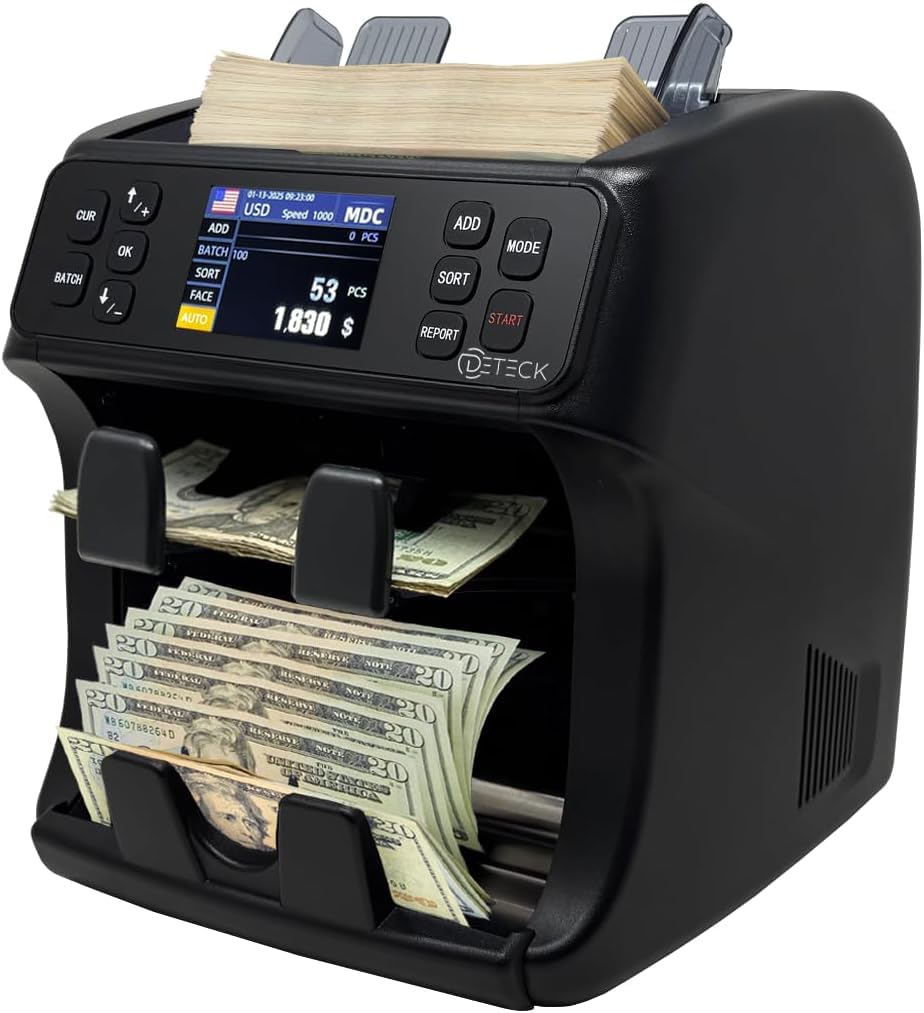
DETECK DT800
If accuracy is your top priority, this machine is built around catching subtle errors and keeping suspect notes out of your totals. You can run mixed stacks and rely on the reject pocket to separate problem bills without stopping the whole count, and the printer/serial features make audit trails painless.
It’s designed for steady daily use, with settings to trade speed for precision when needed, so it’s a good fit when deposits and reconciliations have to be exact.
What People Say
Customers often highlight the DT800’s accuracy in mixed-denomination mode and the convenience of the reject pocket for dealing with suspicious or damaged bills. People appreciate the printer and export options for recordkeeping, and many note that customer service has helped with repairs or firmware questions.
Some common caveats mention occasional trouble with very worn ones or power-related faults, but users usually say those issues are manageable with maintenance or support.
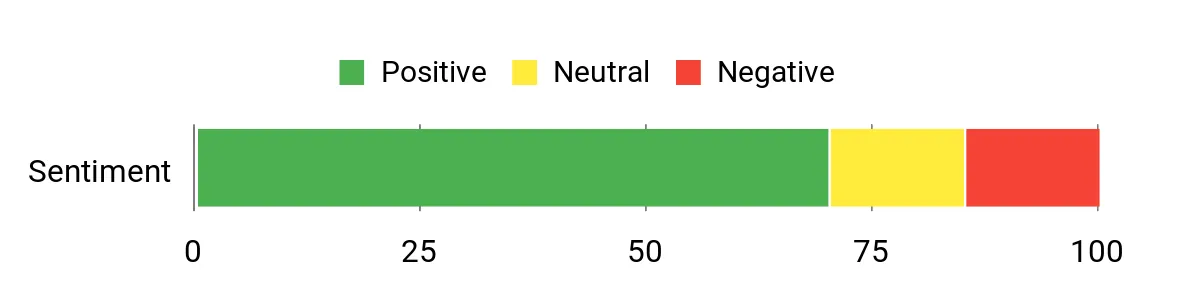
Overall Sentiment: Positive
Versatility
This counter works well for retail stores, cash centers, fundraising events and any operation that needs precise mixed-stack counts and a printed audit trail. Use slower modes for delicate bills, and rely on the reject and batch functions when preparing bank-ready bundles.
Practicality
Expect a brief learning curve for advanced features like serial logging and export, but day-to-day use is straightforward. Keep bills squared and don’t overload the hopper to reduce double-feeds, schedule regular cleaning of sensors, and consider a service plan or contacts for quick support if you rely on it for high-volume daily counts.
Key Benefits
- Reject pocket lets you remove suspect notes without interrupting counts
- Mixed-denomination and mixed-currency capability reduces manual sorting
- Multi-method detection improves counterfeit spotting and reduces risk
- Printer and serial-number logging support audit-ready records
💼 Best for Large Operations
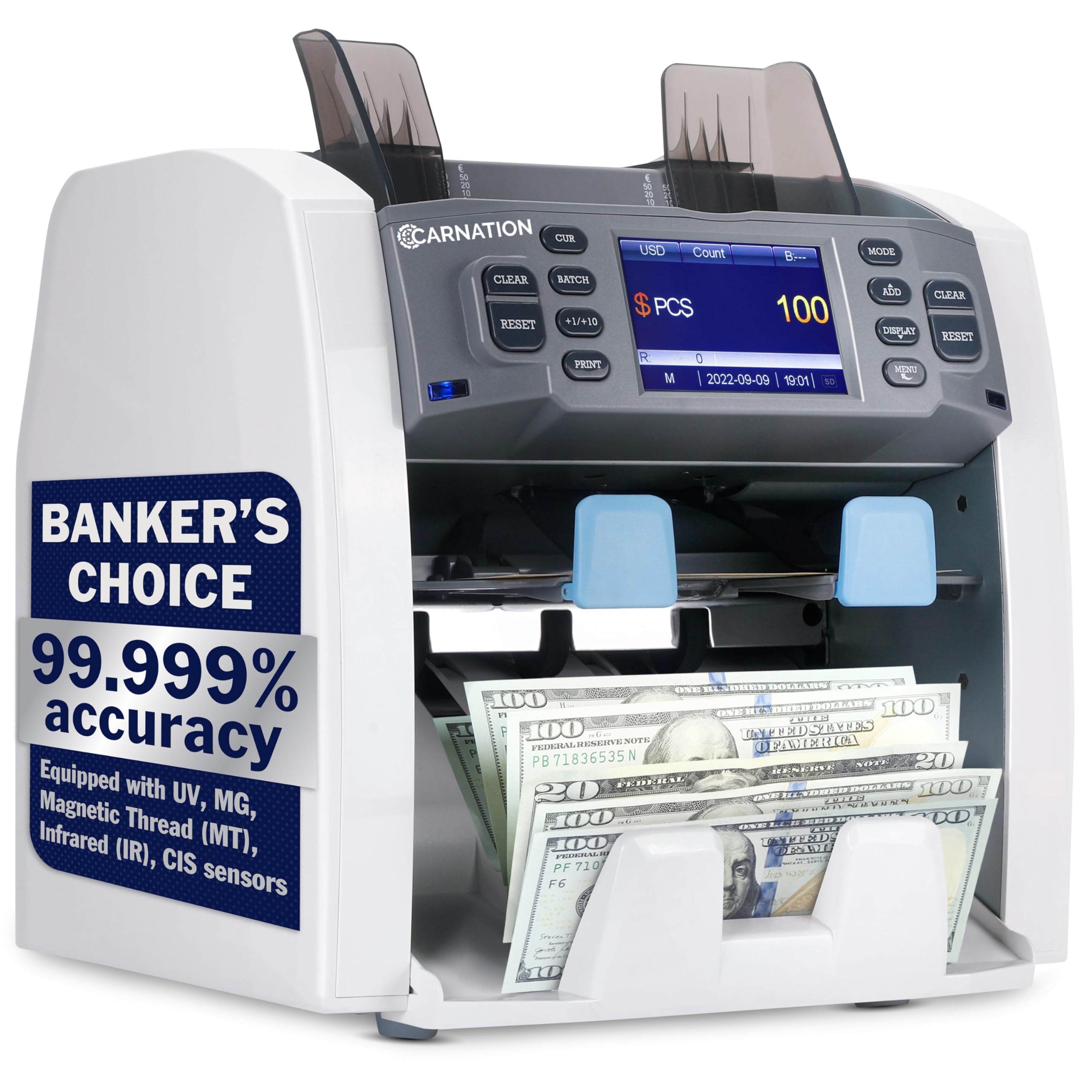
Carnation CR1500
If you handle big volumes, this is the sort of machine that turns a messy pile into organized, bank-ready bundles. You load notes, choose sorting or counting modes and it separates denominations, spots suspect bills and uses the reject pocket so counting keeps moving. It’s built for frequent use, includes customer-facing displays and basic imaging recognition, and works well for daily reconciliations, event cash-outs or back-office prep when you need consistent output without babysitting every stack.
What People Say
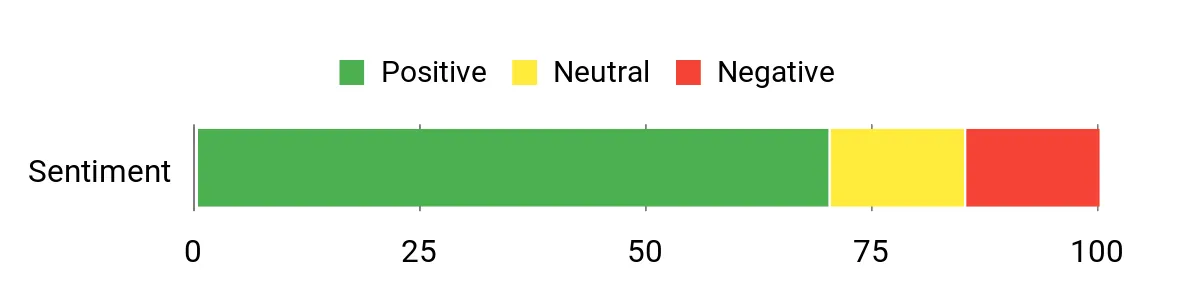
People commonly praise how much time the CR1500 saves when you need neat stacks for deposits, and many like the reject pocket and imaging features that reduce manual sorting. Users also appreciate its straightforward counting and the included accessories, while a few note occasional imaging errors or service hiccups that are usually solvable with calibration or support.
Overall Sentiment: Positive
Versatility
This model is a good match for retail back offices, event cash rooms, and nonprofit or hospitality setups that process large piles of mixed bills. Use sorting for deposit prep, batch mode for standardized bundles, or reject handling when you want uninterrupted counts with problem notes set aside.
Practicality
Setup is simple enough for staff training, and regular sensor cleaning keeps accuracy high; square your stacks and avoid overloading the hopper to reduce jams. If you rely on it daily, plan a short maintenance routine and keep the user manual handy for calibration tips.
Key Benefits
- Reject pocket keeps suspect or damaged notes out of totals without stopping counts
- Sorting and batch modes produce bank-ready denomination stacks quickly
- Multi-method detection and CIS imaging add a layer of counterfeit protection
- Compact footprint with customer display options fits busy counters and back offices
FAQ
How Do I Choose The Right Counter?
Think about what you handle every day: mixed stacks, multiple currencies, or simple note counts. If you often get mixed denominations or foreign bills, pick a unit with mixed-denomination and multi-currency support; if you mainly need fast tallying, a basic counter with batch/add modes will do.
Also weigh features like serial-number logging, printer output, build quality and whether the manufacturer offers firmware updates or local support so the machine stays useful as new notes appear.
Will It Catch Fake Bills?
Most modern counters use several methods—UV, magnetic (MG), infrared (IR), thickness (MT), and advanced image sensors (2CIS/DD)—to flag suspect notes, which reduces risk compared with manual checks. No machine is perfect, so treat an alert as a prompt to inspect the bill visually or run it through a secondary check; using the reject pocket or separate suspect stack keeps your main count uninterrupted while you verify.
How Do I Use And Maintain One Properly?
Square your stacks and avoid overloading the hopper to cut jams, and try manual start when auto mode misbehaves for tricky loads. Clean sensors regularly, keep the dust cover on when not in use, replace fuses or parts per the manual, and install firmware updates when available; teaching a short routine to staff lowers errors and keeps counts consistent.
Wrapping Up
Pick a simple, budget model like the LOLARAN AL1000 if your priority is fast, reliable counts without a big upfront cost. If you need automated mixed-denomination totals, touchscreen controls and multi-currency support, choose a mid- to high-tier model such as the Aneken or Cassida.
For large operations that require sorting, printing and bank-grade detection, aim for the Carnation, Kolibri or MUNBYN units so you get durable hardware and firmware support that keeps counterfeit detection current. Whatever you choose, prioritize accuracy and detection features first so you protect your cash and free up time for running your business.
| Product Name | Image | Counting Speed | Detection Highlights | Dimensions & Weight |
|---|---|---|---|---|
| AL1000 Money Counter Machine |
|
1,000 notes/min |
|
13.11 x 11.73 x 7.4 inches, 10.39 pounds |
| Aneken Mixed Denomination Money Counter |
|
1,200 notes/min |
|
14 x 14 x 14 inches, 18.06 pounds |
| N71 Money Counter Machine |
|
Mixed denomination counting |
|
12.4 x 10.63 x 14.37 inches, 12.25 pounds |
| MUNBYN IMC01 Money Counter |
|
1,200 notes/min |
|
14.17 x 11.81 x 11.42 inches, 17.76 pounds |
| KOLIBRI KBR-1500 V2 Money Counter |
|
1,000 notes/min |
|
15 x 14 x 13.75 inches, 16.46 pounds |
| Cassida 8800R V2 Money Counter |
|
1,000 notes/min |
|
9.45 x 10.43 x 11.02 inches, 12.76 pounds |
We participate in affiliate programs including the Amazon Services LLC Associates Program, or Impact, affiliate advertising programs designed to provide a means for creators to earn fees by linking to websites. We may earn a referral commission from qualifying purchases which supports the site and creation of these reviews.