
A commercial air curtain for a door does something deceptively simple: it mounts above a doorway and pushes a steady column of air downward, creating an invisible barrier between inside and outside. No door slam, no heating bill spike every time the kitchen crew props the back entrance open, no flies drifting in from the loading dock. For restaurants, retail stores, pharmacies, warehouses, and any food-service operation with a frequently opened door, a properly specified commercial air curtain for a door pays for itself in energy savings and pest control within a season or two.
We analyzed 63 commercial air curtains listed on Amazon, scoring each by a composite of star rating and review volume to surface the products with both strong buyer satisfaction and enough reviews to trust the numbers. This is a lower-review category than consumer products by nature: the most-reviewed single unit in the organic dataset has around 375 reviews, because commercial buyers simply don’t leave reviews at the same rate as retail shoppers. That makes volume-weighted scoring more important here, not less.
The short version: the $250–$300 price tier consistently outperforms cheaper alternatives, Awoco dominates the review scoreboard by a wide margin, and the $150–$200 range is where buyer satisfaction reliably drops.
What the Commercial Air Curtain Market Actually Looks Like
Across the 63 commercial air curtains in this analysis, the market average sits at 4.13 stars, which sounds solid until you look at the distribution. Twenty-five products, 40% of the dataset, rate 4.3 stars or better. Sixteen products, just over a quarter, fall below 4.0. The spread is wide, and a meaningful number of 5.0-star listings are propped up by very thin review counts, which the composite scoring accounts for.
The dual peaks at 4.0 and 4.2 stars tell a clear story: “good enough” is the market baseline in this category. Buyers who push into the 4.3–4.5 band find genuine satisfaction. The 5.0-star listings are almost entirely thin-review products, useful to watch as they accumulate feedback but not yet trustworthy enough to rank ahead of products with 150+ verified reviews.
N=63 commercial air curtains with valid rating and price data. Sponsored listings included in distribution chart; excluded from product rankings. Seven listings at 5.0 stars averaged fewer than 5 reviews each.
Sixteen products below 4.0 stars is a notable failure rate for a specialized category. That cluster concentrates in the $150–$200 price range, which the next section unpacks. Buyers in that tier consistently report underpowered airflow, excessive motor noise, and mounting hardware inadequate for a commercial environment.
Does Spending More on a Commercial Door Air Curtain Actually Buy Better Quality?
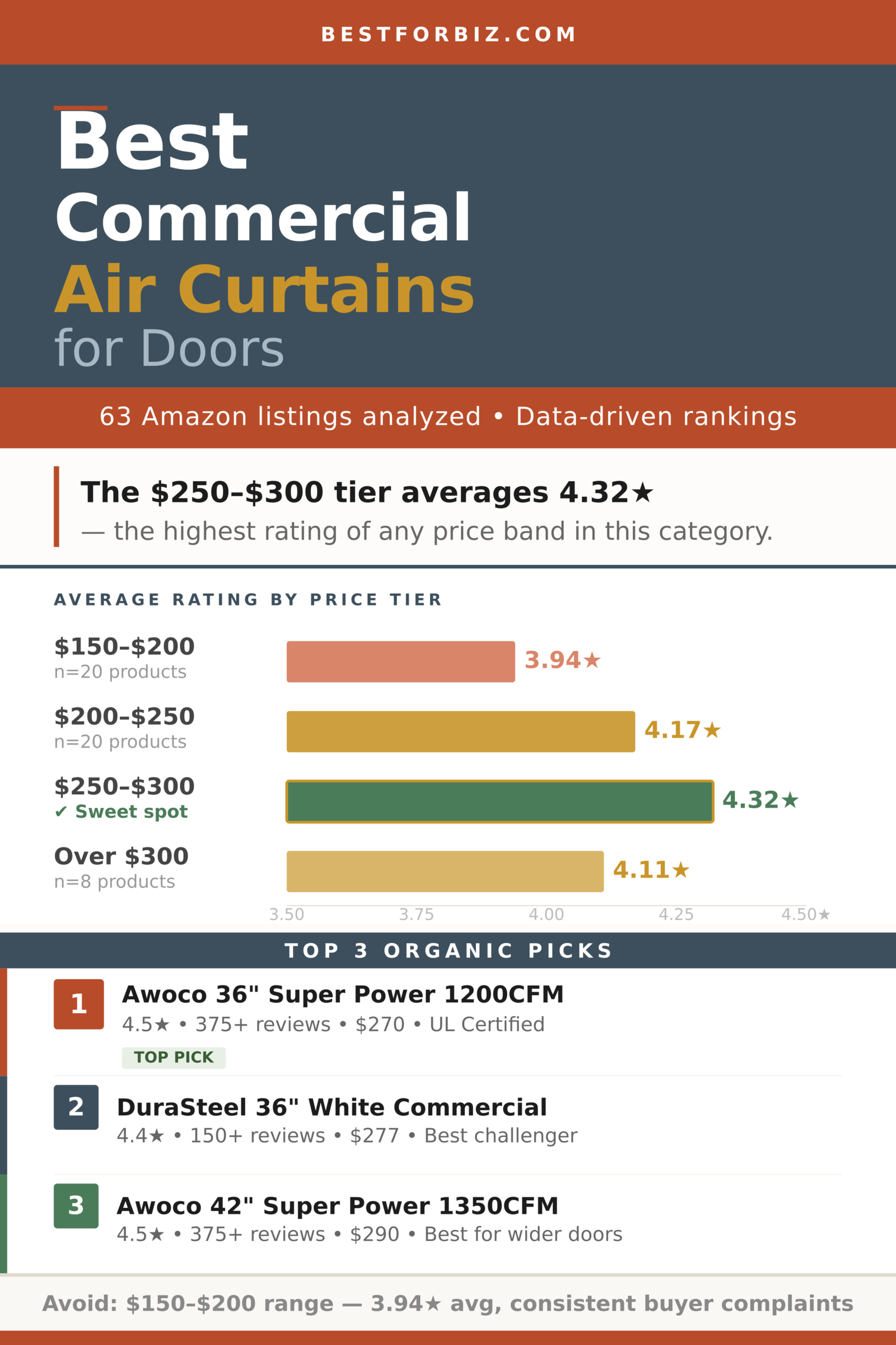
Yes, with one nuance. The $250–$300 range is the clear performance sweet spot, averaging 4.32 stars across 14 products with strong review volume. The $150–$200 range, which looks tempting on a purchase order, averages only 3.94 stars across 20 products. That 0.38-star gap is large for this type of product, and it tracks with consistent buyer complaints about underpowered fans, excessive motor noise, and mounting hardware that does not survive a commercial environment.
The Over $300 tier dips slightly to 4.11 stars, but this does not mean paying more is a mistake. That tier is dominated by wider units: 48-inch and 60-inch models designed for loading docks and double doorways, where the buyer pool is smaller and the use case is more demanding. Those are good products in the right application. The $250–$300 window covers standard 36-inch and 42-inch commercial air curtains for doors with the highest concentration of well-proven units.
Average star rating per price tier across 63 commercial air curtains. “Under $150” contains one product and is shown for completeness only. The $250–$300 tier shows the highest average rating with a meaningful product count.
The $150–$200 tier’s 3.94-star average is not a rounding issue. That band includes several brands with review patterns suggesting poor build quality under higher airflow demands, motor noise that buyers describe as disruptive in retail environments, and mounting kits that are inadequate for commercial use. If your budget sits under $200, it is worth asking whether the application truly requires a commercial air curtain or whether a simpler solution would serve.
For genuine commercial door applications, including restaurants, food retail, convenience stores, and pharmacies, the $250–$300 range is the floor worth considering. The difference between a 3.94-star unit and a 4.32-star unit in this category tracks to airflow volume, motor longevity, and whether the unit still works properly six months after installation.
Top-Rated Commercial Air Curtains for Doors: Organic Rankings
Rankings use a composite score of star rating multiplied by the log of review count, which balances rating quality against the confidence that comes from review volume. A product with 4.5 stars and 375 reviews ranks higher than a 5.0-star product with 8 reviews. All sponsored listings were excluded from these rankings.
Commercial Air Curtains — Ranked by Composite Score
Brand Breakdown: Who Dominates and Who Underdelivers
Six named brands account for the bulk of reviewed commercial air curtains in this dataset. Awoco is the clear market leader by review volume, with 1,870+ total reviews across 10 product listings, more than all other named brands combined. DuraSteel is the primary challenger with 1,080+ total reviews across 7 listings. Both sit in the $275–$295 average price range. Other brands are at varying stages of market credibility: Wostore shows a high average rating but too few reviews to draw firm conclusions, while TURBRO underperforms relative to its peers at a mid-range price.
| Brand | Products | Avg Rating | Total Reviews | Avg Price | Take |
|---|---|---|---|---|---|
| Wostore | 5 | ★ 4.64 | ~30 | $165 | Highest average rating in the dataset, but 30 total reviews across 5 products is too thin to trust for a commercial purchase. Watch as feedback accumulates. |
| Awoco | 10 | ★ 4.39 | 1,870+ | $295 | The established market leader. Most reviews, consistent quality, UL certification, and a product range covering 24" through 48" openings. The default choice for good reason. |
| DuraSteel | 7 | ★ 4.26 | 1,080+ | $295 | Credible challenger with substantial review volume. The best alternative to Awoco in the premium tier, particularly for buyers who prefer a different aesthetic or have had availability issues. |
| Hanchen | 7 | ★ 4.21 | ~90 | $190 | Mid-price brand holding above the $150–$200 tier average of 3.94 stars, which is meaningful. Not proven at scale yet, but worth monitoring for buyers with tighter budgets. |
| Fanspex | 2 | ★ 4.20 | ~60 | $185 | Early-stage brand with consistent ratings and solid buyer feedback on build quality, but too few listings to evaluate reliably. A reasonable consideration for low-traffic commercial doors. |
| TURBRO | 4 | ★ 3.75 | ~40 | $220 | The weakest named brand in this dataset. At 3.75 stars and $220 average, TURBRO is not cheap enough to be a budget pick and not well-rated enough to justify the spend. Avoid until ratings improve. |
Awoco’s review dominance is not subtle: 1,870+ reviews versus DuraSteel’s 1,080+ versus everyone else in the double digits. In a B2B category where review counts are naturally low, that gap represents years of commercial installations. Awoco’s UL certification also distinguishes it from several competitors that are not listed, which matters for food service operators subject to health department inspections.
Wostore’s 4.64-star average at a $165 average price is intriguing, but 30 total reviews across 5 products is not enough data for a confident commercial purchase. The brand’s positioning in the $150–$200 tier, where the category averages 3.94 stars, suggests Wostore may be genuinely better than its tier peers, or the thin sample may not yet reflect the full picture. A buyer equipping a single low-traffic location might consider it; one equipping multiple locations should wait.
TURBRO’s underperformance at $220 is notable because it places the brand in an indefensible position. It costs more than Hanchen and Fanspex but rates below both. It costs less than Awoco and DuraSteel but rates far below. The data does not support a TURBRO recommendation at current ratings.
How to Choose the Right Commercial Air Curtain for Your Door
Most buying decisions in this category go wrong at the specification stage, not the brand selection stage. These are the five questions that determine which unit is right for the application.
Match the air curtain to the door width, not to the next size down. A 36-inch air curtain over a 40-inch opening leaves the edges uncovered, allowing insects and temperature exchange exactly where the barrier is meant to close. Measure the opening width and size up if between standard sizes. A 42-inch unit over a 38-inch door is fine. A 36-inch unit over a 42-inch door is not.
CFM rating determines how effectively the air stream maintains velocity at floor level. A 900CFM unit is adequate for a standard 7–8 foot commercial door. A 1200CFM unit handles 8–10 foot clearance better. For openings taller than 10 feet, step up to the 48-inch or 60-inch models. An underpowered unit mounted too high will not create an effective barrier regardless of brand.
Food service operators should confirm with their local health department whether powered air curtains must be UL listed. Many jurisdictions require it for commercial kitchens and food prep areas. Awoco carries UL certification on its main commercial line; several competitors do not. This can be a non-negotiable requirement rather than a nice-to-have.
The vast majority of commercial air curtains for doors are unheated, and for most temperate-climate applications that is correct. Unheated units create the air barrier but do not warm the incoming air. Heated units are appropriate for cold climates or applications where employees work near a constantly open door. Heated units carry higher purchase and operating costs and are a distinct product category with different compliance considerations.
A magnetic door switch auto-activates the unit when the door opens and shuts it off when the door closes, which is how commercial air curtains are designed to operate. Running a unit continuously when the door is closed wastes energy and adds unnecessary motor hours. Confirm the switch is included before purchase; some listings at similar prices do not include it, adding $20–$30 to the effective cost.
Verdict: Which Commercial Air Curtain for a Door Should You Buy?
The data tells a straightforward story. The $250–$300 price tier outperforms every other band in the analysis, Awoco has earned its market-leading position through consistent quality and the review volume to back it, and DuraSteel is the one credible alternative for buyers who want a proven second choice. Below $200, the category average falls meaningfully, and TURBRO specifically underperforms at a mid-range price that should deliver more.
For most commercial door applications, the standard 36-inch openings with 8-foot clearance where UL certification is required, the Awoco 36" Super Power is the default recommendation. Buyers with wider openings step up to the 42-inch model at $290. Buyers who want a quieter unit for a customer-facing environment consider the 900CFM Elegant model at the same $270 price. DuraSteel’s 36-inch white model is the recommended alternative. Heavy-duty warehouse or industrial door applications step to the 48-inch unit at $410. Nothing in the $150–$200 range earns a clean recommendation from this dataset.
Related business guides: commercial indoor bug zapper guide and industrial freezers for small business guide for more practical business equipment advice.