
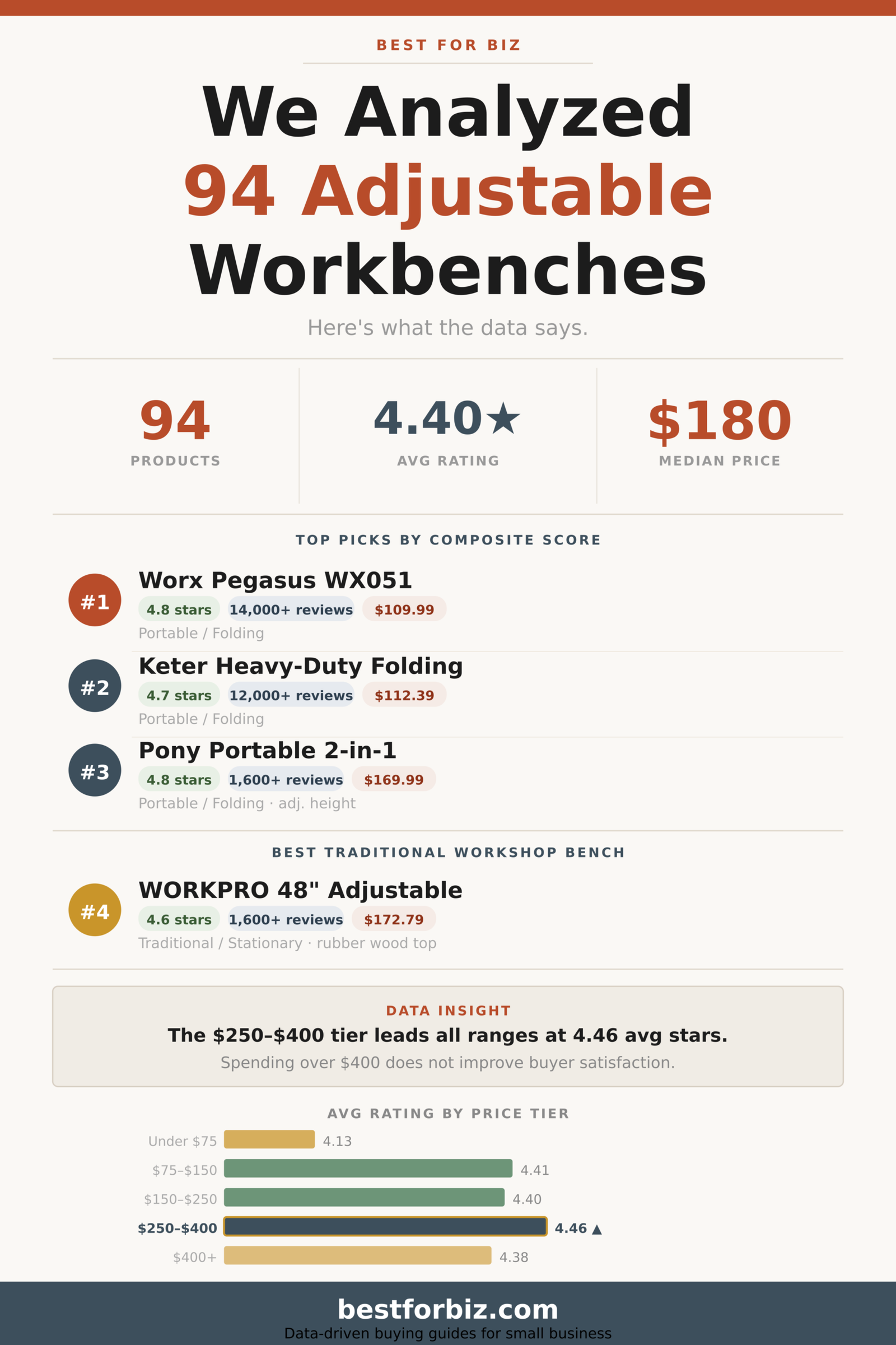
We pulled 127 Amazon listings for “adjustable workbench,” filtered out the gym benches, standing desks, and tool carts that somehow made the results, and analyzed the 94 genuine workshop workbenches that remained. Then we ranked them by composite score — a formula that weights both star rating and review volume, because a 4.9-star product with 12 reviews is a coin flip, not a recommendation.
The result: a clear picture of what the adjustable workbench market actually looks like, which price tiers deliver the best buyer satisfaction, and which six products rise to the top when the data drives the call. The top-ranked workbench has accumulated over 14,000 ratings at 4.8 stars. The median adjustable workbench on Amazon costs $180. And the $250–$400 tier quietly outperforms every other price bracket — including the expensive industrial end.
One thing to flag before the rankings: Amazon’s adjustable workbench results include two genuinely different categories. Most listings are traditional stationary benches with rubber wood tops, pegboards, and built-in power strips. A smaller group is portable folding workbenches in the Worx/Keter mold. Both are legitimate workbenches. Both appear in the rankings. We’ll explain which style suits which buyer.
What the Adjustable Workbench Market Looks Like
The 94 workbenches in this dataset range from $53.99 to $498.99. The median sits at $180, and the market’s average buyer satisfaction lands at 4.40 stars — respectable, though the distribution underneath that average is more interesting than the number itself. Roughly half the market clusters tightly between 4.3 and 4.7 stars. A small tail of underperformers drags the average down, and a disproportionately high cluster of 5.0-star products skews it slightly back up (those are almost always products with very few reviews, where a handful of happy early buyers set an artificially perfect rating).
The 4.6-star bucket is the most populated single rating in the dataset, with 16 products. The 4.4-star bucket is close behind with 14. Together they represent a third of all workbenches analyzed. The message: there is a meaningful cluster of legitimately good workbenches in this market, and the challenge is not finding a rated product — it’s finding one with the right combination of rating and real review volume to trust the score.
N=94 workshop workbenches. Off-category items excluded. Data collected May 2026.
The 5.0-star cluster (8 products) is worth a flag: most of those listings had under 30 reviews. They’re not bad products, but a 5.0 with 8 ratings carries no statistical weight here. The genuinely strong zone — high rating combined with enough review volume to trust the score — runs from 4.5 to 4.7 stars, and that’s where the top-ranked products in this analysis cluster.
The below-4.0 tail (9 products) is small but consistent. Under-rated products in this category tend to share a pattern: vague size specs, cheap steel frames that don’t match the product images, and assembly instructions that assume tools you don’t own. They’re skippable at any price.
Does Spending More Get You a Better Adjustable Workbench?
Sort of. The $250–$400 tier leads on average buyer rating at 4.46 stars, and it has 14 products to support that average. The $75–$150 and $150–$250 tiers are nearly identical at 4.41 and 4.40 respectively, covering 74 of the 94 workbenches analyzed. The $400+ bracket — dominated by Global Industrial’s heavy commercial benches — drops back to 4.38 stars with almost no consumer review volume. You’re not getting more buyer satisfaction by spending more than $400. You’re getting more metal, more load capacity, and a product that was designed for facilities managers rather than garage owners.
The practical read: if your budget is $150–$400, you’re in the workbench market’s quality sweet spot. Below $75, quality gets sparse fast. Above $400, you’re buying industrial spec, and the review signals to validate that purchase are nearly absent.
Y-axis starts at 4.0. N=94 primary workbenches. Avg ratings weighted equally per product (not by review count).
The $150–$250 tier carries the most weight in this analysis: 43 products, the largest single tier, with an average rating of 4.40. This is where most serious buyers land, and the data suggests they’re generally satisfied. The bulk of our top picks fall squarely here.
Two tiers warrant specific caution. Under $75, only 4 workbenches cleared the category filter, and their average sits at 4.13 — the dataset’s weakest. These are mostly bare-steel utility tables that serve the purpose if your standards are flexible. The $400+ commercial tier has the opposite problem: four Global Industrial listings with a combined total of roughly 60 reviews. That’s not enough signal to draw conclusions, and at $450+ a unit, the risk of a bad call is significant without better validation data.
Two Workbench Styles Competing on the Same Search Page
Amazon’s “adjustable workbench” search returns two genuinely different product categories, and confusing them leads to buying the wrong thing. The first is the traditional adjustable workshop bench: a fixed-position table with a rubber wood or hardwood top, height-adjustable legs, a pegboard back panel, built-in power outlets, and load ratings of 2,000 lbs or more. These are permanent garage setups. The second is the portable folding workbench: lightweight clamping tables that fold flat, double as sawhorses, and weigh under 30 lbs. These travel to job sites, open up in seconds, and store in a truck bed or against a wall.
Both legitimately answer the query “adjustable workbench.” But a woodworker buying the Worx Pegasus for heavy power tool use, or a contractor buying a CAMMOO bench expecting to move it weekly, will be disappointed. The section below makes the sub-type clear on each product card.
N=115 usable listings (127 total minus 12 unrated). Off-category items excluded from all rankings and analysis.
Within the 96 workshop workbenches, roughly 15–16% are portable folding-style (Worx, Keter, Pony, BORA sawhorse configurations). The remaining 84% are traditional stationary benches. The portable category punches well above its weight in review volume — the Worx Pegasus alone has more reviews than the entire traditional bench category combined. That means ranking by composite score naturally surfaces portables at the top, which accurately reflects market validation even if it doesn’t reflect the typical garage-shop buyer’s first instinct.
The takeaway: don’t let the ranking order alone tell you what to buy. Read the sub-type label on each card and use the “How to Choose” section below to match the workbench style to your actual use case.
The 6 Best Adjustable Workbenches on Amazon
Rankings use a composite score: star rating multiplied by the natural log of review count. This prevents low-volume outliers (a 5.0-star product with 9 reviews) from outranking proven products. Only organic listings were considered — there were no sponsored placements in this dataset, but the methodology filters for them regardless.
Portable & Folding Workbenches
Traditional Adjustable Workshop Benches
Brand Breakdown: Who Makes the Best Adjustable Workbenches?
Eleven brands appear two or more times in the dataset with enough presence to analyze. Several brand names in the raw data were titles that began with a dimension (“48-Inch Heavy Duty…”) rather than a manufacturer name — those have been excluded from this table as they represent generic or unbranded listings rather than a coherent product line. Only named brands are included. Review totals are approximated since they change daily.
| Brand | Products | Avg Rating | Total Reviews | Avg Price | Take |
|---|---|---|---|---|---|
| FLEXISPOT | 2 | ★ 4.85 | ~40 | $210 | Highest average rating in the dataset; strong hand-crank designs but thin review base — promising, not proven at scale. |
| Seville Classics | 2 | ★ 4.75 | 1,700+ | $391 | The premium-tier standout. High rating backed by meaningful review volume. Positioned for buyers who want a permanent, integrated workstation. |
| CAMMOO | 5 | ★ 4.60 | 1,000+ | $202 | Largest traditional adjustable bench catalog in the dataset. Consistent mid-premium performer across multiple sizes and configurations. |
| ENJOYWOOD | 2 | ★ 4.60 | 150+ | $299 | Strong ratings at a premium price, but limited review depth. Worth watching as the catalog matures; not yet validated at scale. |
| Ultrawall | 2 | ★ 4.60 | 340+ | $116 | Surprisingly strong ratings at a budget price point. Good option for buyers who need solid performance under $130 without brand-name markup. |
| WORKESS | 2 | ★ 4.55 | 580+ | $112 | Competitive value sawhorse-style benches with above-average ratings and enough reviews to trust the score. |
| WORKPRO | 4 | ★ 4.52 | 3,300+ | $204 | Best overall brand in the dataset: deepest catalog, highest total review count, and consistent ratings. The safe choice for traditional benches. |
| LARBANKE | 2 | ★ 4.50 | 350+ | $149 | Solid mid-range entry. Adequate ratings and reasonable review depth for a lesser-known brand at this price. |
| VEVOR | 4 | ★ 4.40 | 460+ | $217 | Large catalog, market-average ratings. Fine for the price, no standout performance. Broad product range trades depth for breadth. |
| Global Industrial | 4 | ★ 4.38 | ~60 | $461 | Heavy commercial/industrial tier. Available in 48″, 60″, and 72″ widths with steel or butcher-block tops. Very low consumer review counts — designed for facilities procurement, not garage buyers. |
| DWVO | 2 | ★ 3.75 | 120+ | $239 | Below-average ratings at a mid-range price. The dataset shows a sub-4.0 average and meaningful review depth. |
WORKPRO is the clear standout for traditional workbenches: four products, 3,300+ combined reviews, and a 4.52-star average that holds across the entire catalog. That kind of consistency is harder to achieve than a single well-reviewed product and tells you the brand has a reliable manufacturing and quality-control process rather than one lucky SKU.
Global Industrial deserves a separate note. Their four listings span 48″, 60″, and 72″ widths in multiple top configurations (birch, maple butcher block, and 12-gauge steel), all priced $400–$500. These are built for commercial facilities use — welded frames, industrial load specs, and commercial lead times. The roughly 60 combined consumer reviews across four products tells you most buyers are purchasing through a procurement channel, not Amazon. If you’re outfitting a professional shop or small manufacturing operation, Global Industrial is worth investigating directly. If you’re fitting out a home garage, the lack of consumer review data at this price tier is a valid reason to pause.
DWVO is the only named brand with a sub-4.0 average and enough reviews (120+) to call it a pattern rather than an anomaly. Both products sit in the $230–$250 range and earn 3.75 stars. That’s a notable gap from the 4.4–4.6 cluster where most of the market performs.
How to Choose the Right Adjustable Workbench
The right adjustable workbench depends almost entirely on how and where you’ll use it. Two minutes thinking through these questions will narrow the field faster than any spec sheet.
If it moves — to a job site, a storage unit, or different parts of a garage — buy a folding portable (Worx Pegasus or Keter). If it’s going in one spot and staying there, a traditional stationary bench with rubber wood top and pegboard gives you more usable surface and integrated storage. Don’t buy a traditional 2,000-lb-rated bench expecting to relocate it easily.
For DIY projects, painting, light assembly, and hand-tool woodworking, any bench over 500 lbs capacity covers you. If you’re setting a table saw or bench grinder on it, look for 2,000+ lb ratings — the WORKPRO and CAMMOO lines both hit this. The folding portables (Worx, Keter) are rated to 300–1,000 lbs, which is more than enough for most DIY use but not for heavy stationary power tools.
Built-in power strips and USB ports show up frequently in the $150–$250 traditional bench range and are genuinely useful if you run multiple tools from one station. The WEN WB4723T includes both outlets and a task light at $150. If you’re buying a portable folding bench, you won’t have outlets — run an extension cord. Simple answer to what sounds like a complicated question.
48-inch is the most common size and covers most garage or workshop tasks. 60-inch benches appear frequently in the dataset (same brands, roughly 15–20% more cost) and are worth it if you’re working with full sheets of plywood or longer stock. Anything over 60 inches is specialty or industrial. Don’t overbuy on width if you’re tight on space — a 48-inch bench occupies 4 feet of wall and leaves room for other things.
Under $150: Ultrawall and WORKESS offer 4.55–4.60-star performance at $110–$130, which the data validates. $150–$250: WORKPRO is the safest traditional bench brand with the deepest review base. $250–$400: CAMMOO and Seville Classics both perform well; Seville if you want integrated LED and pegboard storage, CAMMOO if you want more size options. Over $400: only consider it if you need commercial-spec steel or a specific surface type, and verify Global Industrial’s specs against your actual load requirements before ordering.
Final Verdict
The adjustable workbench market on Amazon is better than it looks at first glance. Most of the recognizable competition clusters between 4.4 and 4.7 stars at prices from $110 to $250, and the data doesn’t show a dramatic quality premium as you move up the price range. The $250–$400 tier has the highest average buyer satisfaction at 4.46 stars — but the gap over the $75–$250 range is just 0.05 stars across 43 products. You’re not buying meaningfully worse workbenches by staying under $250.
The data’s clearest message: buy the Worx Pegasus if your work is mobile or varied. Buy the WORKPRO 48″ if you want a permanent traditional adjustable workbench with a proven track record. Buy the Seville Classics Pegboard Workcenter if you want the best-rated all-in-one premium station the market offers at any price. Skip the sub-$75 tier, and treat the $400+ industrial tier as a different product category entirely unless your use case specifically demands it.
Related business guides: industrial stapler heavy duty picks guide and manual pallet jack for business (2026) guide for more practical business equipment advice.