
Conference speakerphones have become standard equipment for any business with hybrid workers, remote teams, or client calls that need to sound professional. The problem is that Amazon returns nearly 100 results for this category, and they are not all the same thing. To find out which ones actually earn their place on a conference room table, we pulled a full set of Amazon listings and ran every product through a data-based ranking model.
The analysis covers 68 conference speakerphones after filtering out camera systems, standalone microphones, and budget PC speakers that use “conference” loosely in their titles. Products are ranked using a composite score that weights both rating and review volume together, because a 4.9-star product with 12 reviews tells you very little. Sponsored listings were identified and set aside so the rankings reflect organic market performance only.
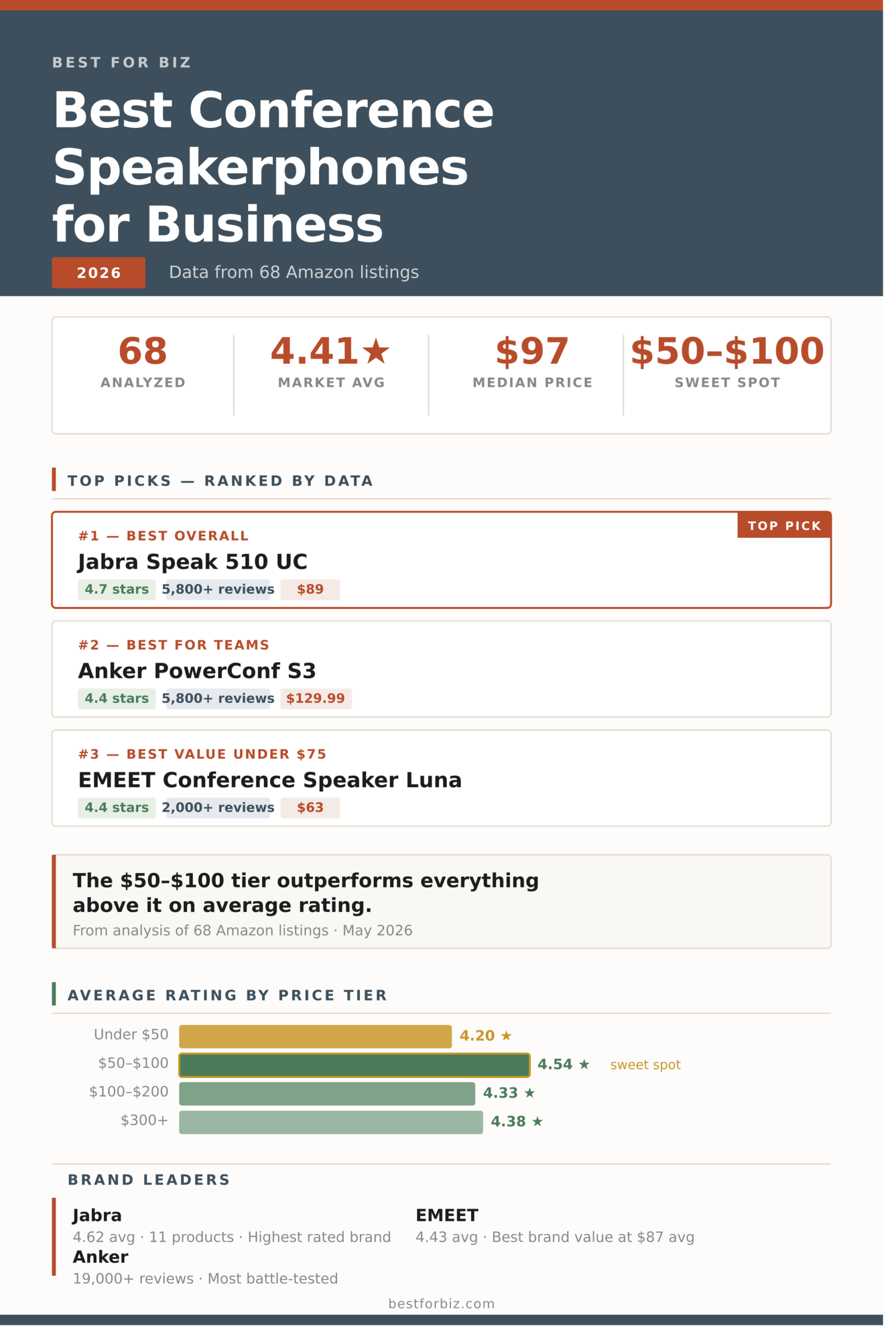
The short version: the $50–$100 tier outperforms everything above it on average rating, Jabra leads the brand table by a meaningful margin, and Anker has earned more combined reviews than any other brand in the dataset. Here is what the data shows.
How Conference Speakerphones Are Rated on Amazon
Across all 68 conference speakerphones in the dataset, the average rating sits at 4.41 stars — higher than most Amazon categories and a sign that buyers in this space tend to know what they need before they buy. The distribution is not the typical sharp bell curve. It has an unusually thick tail at the high end, with nearly a third of products rated 4.6 or above.
That said, 18% of the market sits below 4.0 stars. Those products tend to cluster in two areas: very cheap generic units making ambitious claims about pickup range, and older models from enterprise brands that have been superseded by newer hardware but remain listed. Budget does not automatically mean low-rated, but it is where most of the sub-4.0 ratings live.
N=68 conference speakerphones (organic and sponsored combined). Products with missing ratings excluded. Sponsored listings analyzed separately for rankings.
The 4.4–4.5 band is the most crowded part of the market, holding 18 products, and that is not accidental. At this rating level, Amazon’s algorithm rewards the listings and buyers self-select toward them, creating a competitive cluster where brands fight hard to maintain position. Dropping below 4.3 is usually a slow decline toward lower search visibility.
The 4.8-and-above tier has nine products and deserves scrutiny. High ratings with low review counts appear here more often than anywhere else in the dataset. A 5.0 rating on 12 reviews is statistically meaningless for a hardware product that will encounter dozens of different room sizes, Zoom versions, and IT setups. The rankings below weight volume alongside rating to avoid promoting products whose stars have not yet been stress-tested.
Does Spending More Actually Buy Better Audio?
The relationship between price and quality in conference speakerphones is not what most buyers assume. The $50–$100 tier averages 4.54 stars across 27 products, the highest of any price band in the dataset. The $100–$200 tier, which holds the largest name-brand models from Anker and Poly, averages 4.33 stars — meaningfully lower. Spending twice as much does not reliably buy a better-reviewed product.
The $300+ tier (six products) averages 4.38 stars but with very thin review counts. Those products are built for larger rooms and enterprise procurement cycles, which generate fewer consumer reviews. They may perform excellently in their intended environments, but the rating data is thin enough to treat with caution.
N=68 products. Baseline set at 3.5 stars to show relative differences clearly. The $200–$300 tier has only 4 products; interpret with caution.
The practical implication is straightforward: for most small and mid-size businesses running calls in rooms up to ten people, the $50–$100 tier is where the market has converged on a reliable baseline. Above $100, you are mostly paying for specific features — longer battery life, daisy-chain capability for large rooms, app-based equalization, or premium brand certification programs — not for a blanket improvement in call quality ratings.
There is also a notable dropoff in review volume above $200. The $100–$200 tier averages over 1,100 reviews per product, while the $300+ tier averages just 33. That gap reflects both lower sales volume and the fact that enterprise buyers rarely review products publicly. It does not mean premium products are worse, but it does mean you have much less community signal to rely on when evaluating them.
What Amazon’s Results Actually Contain
A search for “conference speakerphone” on Amazon does not return only conference speakerphones. Of the 96 total listings we pulled, 81 were genuine speakerphones. The remaining 15 split across three other product types: camera-speakerphone combo systems (8 listings), basic desktop PC speakers with a microphone and “conference” in the title (5 listings), and standalone USB microphones (2 listings).
The camera-speakerphone combos, priced between $240 and $720, are a genuinely different product. They are room-scale video conferencing systems where the speakerphone is secondary to a PTZ or 360-degree camera. They were excluded from rankings and charts. The PC speakers and standalone mics were excluded on the same basis: they are not conference speakerphones in the functional sense, even if they work fine for a solo user on a laptop call.
N=96 raw listings pulled from Amazon search. Composition reflects the raw results before filtering for this analysis.
The camera combos deserve a separate mention for buyers who may genuinely need them. Products like the Insta360 Wave and Insta360 WaveLink are designed for conference rooms where video presence matters as much as audio. They carry a $240–$720 price tag and compete in a different category against Owl Labs and dedicated room systems. If your setup requires both a quality wide-angle camera and a speakerphone in one unit, those products are worth evaluating on their own terms.
For everyone else, the 68 speakerphones analyzed here cover the full range from a $30 entry-level puck to a $413 multi-room daisy-chain system, and the rankings below are based entirely on that filtered set.
Best Conference Speakerphones for Business: Ranked Picks
Rankings use a composite score: star rating multiplied by the natural log of review count, applied to organic listings only. This model rewards products that maintain high ratings under real-world volume. A product with 4.7 stars and 5,800 reviews outranks a 4.9-star product with 20 reviews because the latter has not been stress-tested at scale. Value scores (composite score relative to price) were used to identify the best-value picks.
Top-Rated Conference Speakerphones
Brand Breakdown: Who Makes the Most and Who Makes the Best
Seven brands appear with two or more products in the cleaned dataset. The table below reflects average ratings, total review counts, and average pricing across their full Amazon presence in this category — not just their flagship model. Review totals are approximated.
| Brand | Products | Avg Rating | Total Reviews | Avg Price | Take |
|---|---|---|---|---|---|
| Jabra | 11 | ★ 4.62 | ~7,000 | $159 | The clear quality leader. Highest average rating of any brand with meaningful volume, and the widest range from $88 travel units to $344 premium models. |
| EMEET | 6 | ★ 4.43 | ~5,000 | $87 | Best brand value in the dataset. Strong average rating at the lowest average price of any established brand. Three of the top six picks are EMEET products. |
| Anker | 4 | ★ 4.40 | ~19,000 | $131 | The most reviewed brand in the dataset by a wide margin. PowerConf line has accumulated more consumer signal than any competitor, making it the lowest-risk buy for first-time purchasers. |
| Poly | 4 | ★ 4.38 | ~200 | $260 | Solid hardware at a premium price, but very thin review volumes on Amazon suggest most Poly buyers go through enterprise channels rather than retail. Good if IT has standardized on it; harder to evaluate otherwise. |
| Yealink | 8 | ★ 4.29 | ~230 | $140 | The most products of any brand in the dataset, but the lowest average rating at the highest average price among established brands. Yealink’s strength is enterprise VoIP infrastructure, not consumer Amazon reviews. |
| Microsoft | 3 | ★ 4.27 | ~3,800 | $67 | Decent review volume and a low average price, but the ratings trail Jabra and EMEET. Best for Teams-standardized environments where the Microsoft certification matters more than third-party options. |
| Generic / No-Brand | 16 | ★ 4.49 | ~2,500 | $108 | The largest single group in the dataset. Average rating is surprisingly competitive, but no individual product has enough reviews to recommend with confidence. Good for price-shopping experiments, not for equipping a permanent room. |
Anker’s review total of roughly 19,000 across four products is the defining data point in the brand table. More reviews mean more edge cases encountered and documented, which gives buyers a much clearer picture of failure modes. The PowerConf line’s most common criticisms — occasional Bluetooth pairing friction and mediocre call-ending button UX — are well-catalogued and minor enough that they have not dented the 4.4-star average.
Yealink’s position in the table deserves a closer look. Eight products averaging 4.29 stars at $140 is not a strong showing for a brand with serious enterprise credibility in VoIP hardware. The disconnect is contextual: Yealink’s strength is SIP-based desk phones and video conferencing systems sold through IT procurement, not USB speakerphones bought on Amazon. The SP92 variants clogging their Amazon listing count are a consumer-facing push that has not yet generated the review volume to compete with Jabra or Anker on data-driven comparisons.
The generic group’s 4.49 average rating is the statistical outlier in the table. It reflects survivorship bias: poorly rated no-brand products get de-listed faster than established brands, so what remains tends to look better than the full historical distribution. Treat individual generic picks with more caution than the category average suggests.
How to Choose the Right Conference Speakerphone
Room size, call frequency, and platform standardization are the three variables that actually determine which speakerphone is right for a given setup. The framework below covers the most common decision points.
Up to 6 people in a small conference room: any pick in the $50–$100 tier covers this well. The EMEET Luna and M0 Plus both handle up to 6 participants. For rooms with 8–12 people at a longer table, look at the Jabra Speak 510 or consider daisy-chain options like the Jabra Speak 710, which can be paired wirelessly for longer coverage without a cable run.
Permanent rooms benefit from wired USB connections — no battery management, no Bluetooth pairing, simpler IT support. The Anker S330 is the strongest wired pick in the dataset. Portable units for hot-deskers or travelers should be Bluetooth-capable and compact; the Jabra Speak 510 handles both modes and weighs very little.
Platform certification matters more for Teams than for Zoom. Teams has stricter hardware certification requirements, and Microsoft-certified devices sometimes get direct call-control button support (mute, answer, end). If your organization is Teams-standardized, look for “Microsoft Teams Certified” or “UC” designations. Jabra’s UC-certified line works across both platforms without issues.
Not much, in isolation. As the data shows, several products with 5.0 ratings carry fewer than 20 reviews — which is statistically useless for a hardware product with dozens of possible failure scenarios. Use the rating in combination with review count. Products above 4.3 stars with 500+ reviews have enough signal to trust. Anything with under 100 reviews should be treated as provisional.
The sub-$30 tier has consistently poor ratings in this dataset and almost no products with enough review volume to evaluate. At $30–$45, the quality improves but remains variable. The EMEET M0 Plus at $50 is the lowest-priced product we can recommend with data confidence. Below that, you are making a speculative purchase.
Final Verdict
Across 68 conference speakerphones analyzed, the market’s center of gravity sits between $50 and $100, where average ratings outperform every more expensive tier. Jabra leads on quality by a clear margin, Anker leads on review volume and market trust, and EMEET delivers the best combination of price and performance of any established brand. The generic segment is large but individually unproven.
For most businesses, the Jabra Speak 510 UC at $89 is the least-risky recommendation in the category — it combines the highest composite score in the dataset with a price that does not require budget approval escalation. Teams equipping multiple rooms on a tighter budget should look hard at the EMEET Luna at $63. Buyers who need to cover a room of 10 or more people should go straight to the Jabra Speak 710 and not try to stretch a single small-room device beyond its design intent.
Related business guides: office coffee makers for small businesses guide and upgrade your workspace with these top ergonomic chairs guide for more practical business equipment advice.