
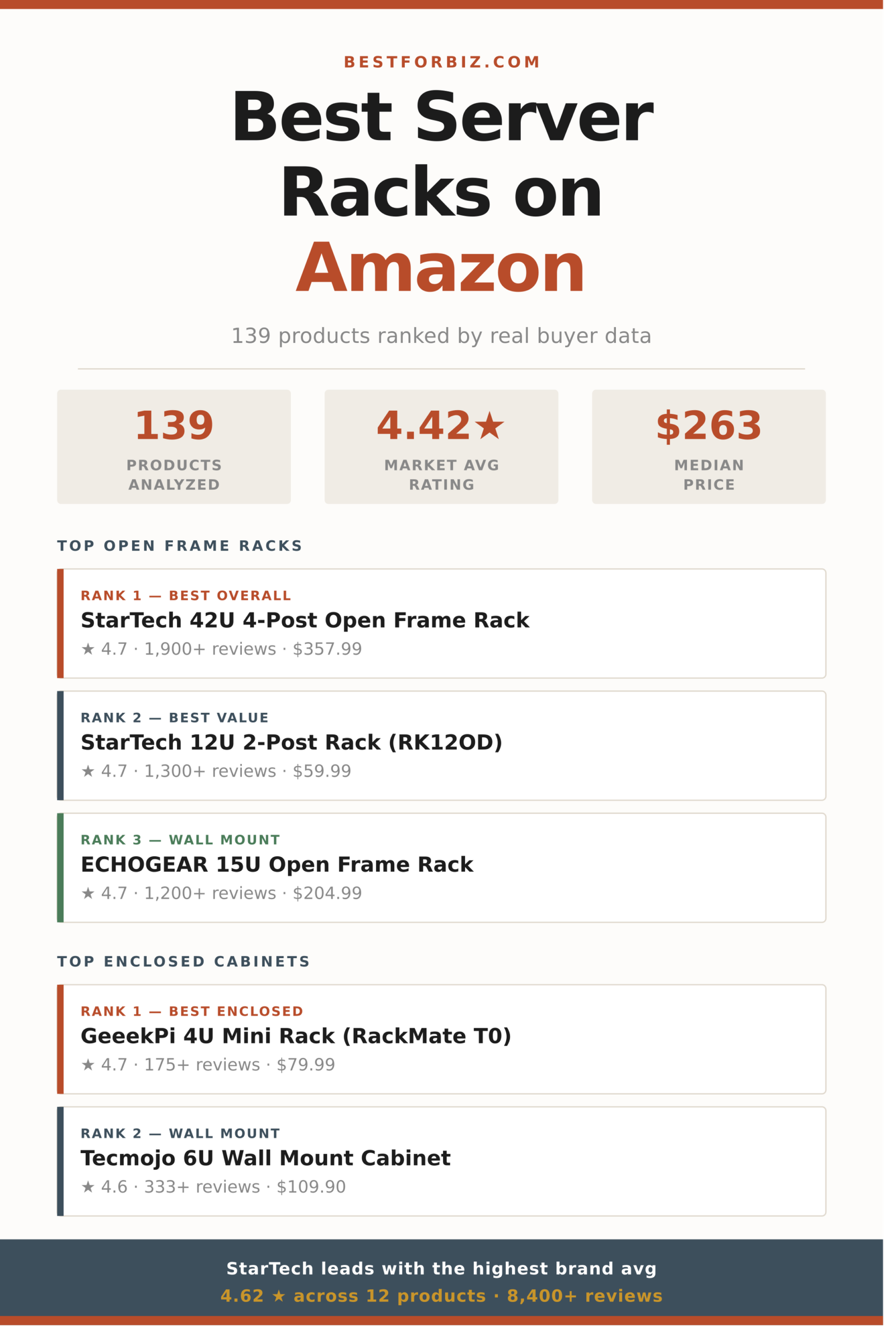
Buying a server rack or network cabinet on Amazon should be simple. In practice, the search results are a maze: 42U floor-standing giants next to 4U desktop enclosures, open frames mixed with locked cabinets, and enough branded noise to make a reasonable IT buyer give up and just repurpose a shelf. We pulled 150 listings from Amazon’s server rack search results and ran the numbers so you don’t have to.
After removing sponsored placements and listings with missing data, we scored 139 products across rating, review volume, price, and product type. The market splits cleanly into two categories: open frame racks (ventilated, accessible, preferred for controlled environments) and enclosed cabinets (lockable, dust-resistant, better for shared spaces or offices). Each category has a different buyer profile and a different price curve, and conflating them is how people end up buying the wrong thing.
The overall market rating sits at a healthy 4.42 stars, with the median unit priced at $263. The $800+ tier actually posts the best average ratings, but you don’t need to spend four figures to get a solid performer. Three brands, StarTech, NavePoint, and Tecmojo, account for more than a third of all listings and dominate the top-reviewed segment. Here’s what the data shows.
How the Server Rack Market Is Rated
The server rack category skews high-performing on Amazon, but it’s not uniformly so. Nearly half of all primary products (47%) land between 4.4 and 4.6 stars, forming a reliable “good enough” middle tier. The true standouts, products rated 4.7 and above, represent about 14% of the market. At the other end, only 5 products scored below 4.0, which means the floor in this category is reasonably high. Buyers aren’t regularly stuck with poor-quality racks.
N=118 primary server rack products (accessories excluded). Sponsored listings removed. Data collected May 2026.
The 4.6-star bin is actually the single most populated rating point with 21 products, just edging out 4.4 (19 products). Together, these two ratings account for one-third of all primary listings. Products below 4.0 are rare enough that you’re unlikely to accidentally buy one unless you’re hunting for the cheapest possible price regardless of quality.
One thing worth noting: this category has an unusually thin tail of 5.0-star products. Only 3 listings hit a perfect score, and all of them have low review counts, which typically means the rating hasn’t been stress-tested at scale. When you see 5.0 stars on a rack with fewer than 20 reviews, hold that rating loosely.
Does Spending More Get You a Better Server Rack?
The relationship between price and quality in this category is more nuanced than a simple “pay more, get more.” The data shows a slight U-curve: budget options under $100 actually rate well (4.40 avg), mid-range racks in the $100–$400 band are competitive but not dominant, and the $800+ tier posts the category’s best average at 4.54. The weakest tier by rating is $400–$800, which happens to be where a lot of medium-depth enclosed cabinets live.
N=107 primary products with complete price and rating data. Accessories excluded. Highlighted bar (gold border) = best value tier by rating-to-cost ratio.
The $200–$400 band is the standout value zone. It contains the largest number of products (36), rates second-best overall (4.45), and covers most practical use cases: 12U to 25U open frames, mid-depth enclosed cabinets with locking doors, and wall-mount units with casters. This is where brands like StarTech, NavePoint, and ECHOGEAR do their best work.
The $400–$800 tier’s weaker average (4.34) is partly a category artifact. This range is dominated by larger enclosed cabinets and commercial-grade open frames that attract more demanding buyers with higher expectations. A 4.34-star rating isn’t bad, it’s just that the competition at this price point is stiffer. If you’re shopping here, be more selective, not less.
Open Frame vs. Enclosed Cabinet: Which Type Do You Need?
The 139 products in this dataset split almost evenly between open frame racks (61 primary units) and enclosed cabinets (57 primary units), with 21 accessories making up the remainder. This near-even split reflects the market reality: both types serve distinct buyer profiles, and neither is the wrong choice if you understand what you’re buying.
Open frame racks, typically 4-post or 2-post designs, prioritize airflow and accessibility. Cable management is visible, equipment is easier to swap, and cooling is simpler because there’s no enclosure to trap heat. They’re the standard in dedicated server rooms, data closets with controlled access, and AV installations. Enclosed cabinets, by contrast, add lockable doors, side panels, and often integrated fan units. They’re the right call when the rack lives in a shared space, an office environment, or anywhere physical access control matters.
Accessories (shelves, PDUs, blanking panels, drawer units) were identified and excluded from the primary rankings. They appear in a companion section below.
Because the two types rate and price differently, the rankings below are split by type rather than combined. An open frame rack and an enclosed cabinet are not substitutes for each other. Comparing them on a single ranked list would be like ranking sedans against pickup trucks, technically possible but not particularly useful to someone who already knows which type they need.
Top Server Rack Picks by Type
Rankings weight organic buyer rating (primary factor) against review volume (credibility signal). A product rated 4.7 by 1,900 buyers ranks above one rated 4.8 by 12 buyers. Sponsored listings were excluded from all rankings. Accessories analyzed separately.
Open Frame Racks
Enclosed Network Cabinets
Brand Breakdown: Who’s Actually Worth Buying?
The server rack market on Amazon has a clear tiered structure by brand. A handful of names appear repeatedly with enough review volume to form a reliable opinion on, while the long tail is full of house brands and single-listing importers with no track record. The table below covers brands with at least two products in the dataset, ranked by product count.
| Brand | Products | Avg Rating | Total Reviews | Avg Price | Take |
|---|---|---|---|---|---|
| Tecmojo | 14 | ★ 4.36 | 1,500+ | $163 | Dominant at budget wall-mounts. Consistent but not exceptional. Best option under $150 for enclosed cabinets. |
| NavePoint | 13 | ★ 4.48 | 6,100+ | $349 | Strong mid-range brand with the most combined review volume in the dataset. Reliable across both open and enclosed lines. |
| StarTech | 12 | ★ 4.62 | 8,400+ | $492 | Highest brand average rating in the category and the most total reviews. The default choice if quality and validation matter more than price. |
| RIVECO | 6 | ★ 4.35 | 552 | $251 | A newer entrant with reasonable ratings and competitive pricing. Limited review depth makes it a wait-and-see for now. |
| VEVOR | 5 | ★ 4.16 | 1,559 | $142 | Lowest brand average in this table. VEVOR’s broad multi-category presence means quality control varies. Fine for light-duty AV gear; skip for server loads. |
| ECHOGEAR | 4 | ★ 4.53 | 1,874 | $238 | Small product line but strong ratings across it. Their wall-mount open frame design is a category best. Worth seeking out for the $200–$250 range. |
| RackPath | 4 | ★ 4.45 | 618 | $144 | Solid budget open frame option with decent validation for a newer brand. Lower price point than most of the competition for comparable specs. |
| Tripp Lite | 3 | ★ 4.50 | 135 | $851 | Legacy brand with enterprise roots. Appears at the premium end here. Limited review count for the price; best evaluated on spec sheets rather than Amazon reviews. |
| GeeekPi | 3 | ★ 4.60 | 608 | $122 | Specialist in compact 10-inch mini rack format. High ratings across a small, focused product line. Only relevant if you’re building a homelab or micro rack setup. |
| Sysracks | 2 | ★ 4.60 | 83 | $1,389 | Premium-priced full-height cabinets with strong early ratings, but thin review counts at this price point. Evaluate carefully before committing. |
StarTech is the clear data leader: highest brand average rating (4.62), the most combined reviews in the dataset (8,400+), and a product line that spans budget 2-post racks all the way to enterprise 42U floor units. The $492 average price reflects where they play, not what they charge for entry-level products. Their 12U 2-post rack at $59.99 is one of the cheapest units in the entire dataset with a 4.7-star score.
VEVOR is the one name worth flagging as a risk. Their 4.16 average across 5 products is the lowest brand average in the table, and the pattern here matches what you see in other categories: VEVOR’s scale and pricing attract buyers looking for the cheapest option, and the ratings reflect it. For AV gear or light home use, the risk is manageable. For anything server-related where uptime and physical integrity matter, it’s a skip.
ECHOGEAR deserves more attention than it gets. Four products, all well-rated, with nearly 1,900 combined reviews, at a brand average of 4.53. That’s a tighter, more curated catalog than Tecmojo or NavePoint, and the per-product review volume suggests each unit has been genuinely stress-tested by buyers. If you land in the $200–$250 range, their wall-mount open frame line should be on your shortlist.
How to Choose the Right Server Rack for Your Setup
The framework below cuts through the most common decision points. Most buyers get stuck on unit count (how many U?) and miss the more important variables: environment, depth, and access requirements.
Controlled environment (dedicated server room, IT closet with access restrictions): open frame is fine and usually preferable for airflow and cable access. Shared space (office, retail area, school, anywhere others can physically reach it): enclosed cabinet with locking door is the right call. This single question eliminates half the market for most buyers.
Most 1U switches and patch panels are under 12 inches deep. Most 1U/2U servers are 24–32 inches deep. Standard wall-mount cabinets run 15–24 inches deep; full floor units typically offer 24–40 inches. Measure your deepest planned equipment before buying. Buying a 17-inch deep cabinet for a 28-inch server is a common and expensive mistake.
42U racks are for data centers and large server rooms. Most small businesses and home setups are well-served by 12U to 25U. A 12U unit holds 12 standard rack units of gear, which covers a firewall, a managed switch, a patch panel, and a UPS with room to spare. Buying more rack than you need wastes floor space and makes cable management harder. Size to your 3-year plan, not your 10-year plan.
Wall-mount units work well up to about 12U for lighter loads. Beyond that, the wall anchoring requirements become demanding and most buyers switch to floor-standing units with casters. If you’re at 12U or under, wall mount keeps the rack off the floor and out of the way. At 15U+, floor mount with locking casters is the practical choice.
AV equipment often runs hot and benefits from maximum airflow, making open frame the default. Networking gear (switches, patch panels, firewalls) works in either type but rarely needs the weight capacity of a full server rack. Actual servers, especially 2U or larger, need deeper racks, higher weight ratings, and ideally PDUs already planned into the build. Buy for the actual equipment you’re installing, not the most prestigious rack in the category.
The Verdict
The server rack and network cabinet market on Amazon is better than it looks. Despite 150 listings that initially appear chaotic, the underlying quality distribution is solid: more than 60% of primary products rate 4.4 stars or above, and the sub-4.0 tier is genuinely rare. The decision framework matters more than the specific brand: nail down your environment, depth requirements, and unit count first, then shop brands.
StarTech dominates on validated quality across price points. NavePoint is the most reliable mid-market choice with the deepest review base. Tecmojo owns the budget wall-mount enclosed segment. ECHOGEAR is the underrated pick in the $200–$250 open frame space. The $200–$400 band delivers the best combination of selection, rating, and value for most buyers.
Related business guides: external hard drives for business guide and wifi range extenders for the office guide for more practical business equipment advice.