
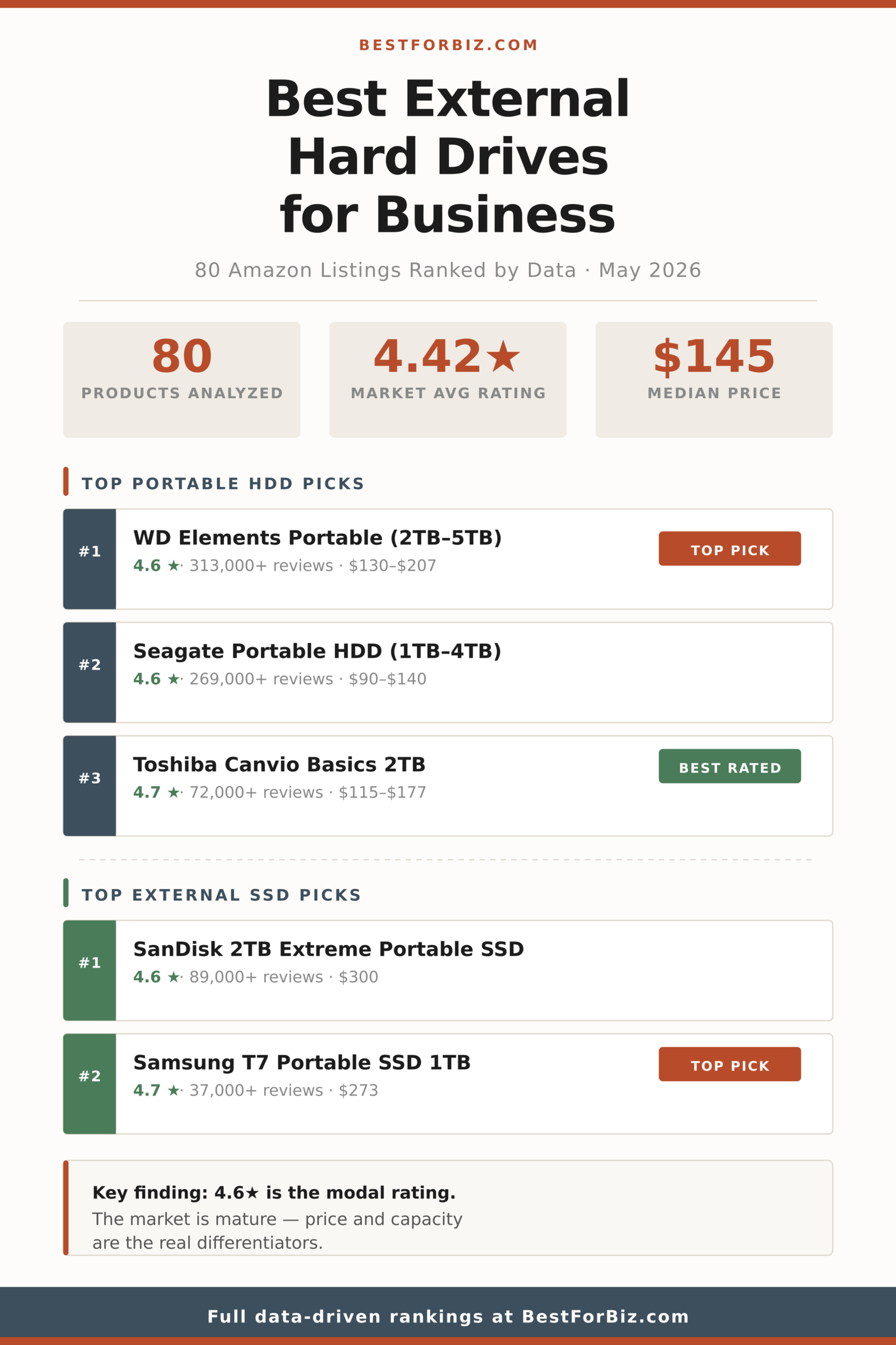
The external hard drive market splits into two very different buyer decisions: you’re either shopping for storage capacity per dollar, or you’re paying a premium for flash-speed performance. Portable HDDs dominate the category by volume — they account for roughly 76% of Amazon’s organic results — but external SSDs have built a genuine foothold in the $150–$300 range, backed by review totals that rival the HDD incumbents. This analysis covers 80 listings across both types, ranked by a combined score of rating and review weight, with accessories excluded from the rankings.
The market is heavily consolidated around two brands. WD and Seagate together account for a majority of the high-review-count listings, and both deliver consistent 4.6-star averages across their portable lines. The interesting action is at the margins: Toshiba’s Canvio line punches above its recognition level, Samsung holds the top average rating in SSDs, and the under-$50 HDD segment is dominated by slim-form budget drives that trade speed and build quality for aggressive pricing.
If you’re buying for a small business context — file backup, point-of-sale data archiving, media storage for a studio — the sweet spot in this dataset is clear: $100–$150 for HDDs (4.46 average rating), and $270–$290 for SSDs when speed matters. Here’s what the data shows.
How the External Hard Drive Market Is Actually Structured
Across 80 organic listings, ratings cluster tightly in the 4.4–4.6 band, which tells you most of what you need to know about this category: it’s mature, competitive, and difficult to differentiate on quality alone. The average rating is 4.42 stars, with the modal rating at exactly 4.6 — claimed by 25 of the 80 products analyzed. Only 6 products fell below 4.0 stars, and those were either niche ultra-capacity desktop drives or no-name budget entries with thin review bases.
The review distribution reinforces this consolidation story. The top products — WD Elements and Seagate Portable lines — carry 270,000 to 313,000+ reviews each, numbers that smaller competitors simply cannot manufacture. Below those flagship lines, the drop-off is steep: third place by review count sits around 90,000. That concentration matters when you’re making a business purchase decision, because review volume at scale is one of the most reliable quality proxies in consumer hardware categories.
N=80 organic listings. Ratings rounded to one decimal. Data collected May 2026.
What this distribution communicates clearly: the bottom of the market is thin and risky. Products below 4.0 stars represent a small fraction of listings, and they tend to share two traits — low review counts (under a few hundred) or extreme capacity/price points that serve a very narrow professional use case. For a business buyer, nothing below 4.3 stars with under 1,000 reviews is worth the risk.
The 4.4–4.6 range is where you’re shopping. The question becomes not “is this drive reliable” — they mostly are — but “which drive gives me the best capacity-to-dollar ratio at the right form factor.” That’s where price tier analysis earns its keep.
Does Spending More Get You a Better-Rated Drive?
Mostly, yes — but only up to a point. The $150–$250 tier is the sweet spot by average rating (4.49 stars), and it’s also where the largest concentration of products sits (24 of 80). The under-$50 and $250+ tiers both underperform relative to the middle, for different reasons: budget drives attract buyers who often have lower expectations or are returning items when they don’t work out, and the premium tier includes some high-capacity desktop drives with mechanical reliability complaints that drag averages down.
The most actionable takeaway: the $100–$150 tier delivers 4.46 average stars across 20 products, which is nearly indistinguishable from the $150–$250 tier in rating terms. You’re paying more in the upper range mostly for additional storage capacity, not meaningfully better hardware quality.
N=80. Average ratings per price tier. The $150–$250 range is the best-performing tier; $250+ includes high-capacity desktop drives with lower satisfaction scores.
The $250+ underperformance is worth unpacking. That tier is dominated by large-capacity desktop HDDs (6TB, 8TB, 22TB) and premium SSDs. The desktop drives drag the average down — they carry vibration, noise, and reliability concerns that portable drives don’t, and buyers notice. The premium SSDs in this range perform well, but they’re fewer in number and can’t offset the desktop HDD drag on their own.
For a business buying portable storage, this data suggests a ceiling around $250 before you start paying for size rather than quality. The lone exception: external SSDs, which earn their premium across the $270–$300 range through a combination of durability, speed, and a buyer profile that tends to rate more carefully.
HDD vs. SSD: Which Type Dominates Amazon Results
Traditional spinning-disk HDDs still control this search category by a wide margin. Of the 80 products analyzed, 61 were HDDs (a mix of portable and desktop form factors) and 19 were SSDs. That’s a 76/24 split. But the SSD slice carries a disproportionate share of the high-engagement reviews — SanDisk’s Extreme line alone accounts for nearly 90,000 reviews, and Samsung’s T7 family brings another 54,000+ combined.
The split reflects two genuinely different buyers. HDD buyers are optimizing for cost-per-terabyte — a 5TB portable drive at $207 is hard to beat on raw storage economics. SSD buyers are prioritizing speed and portability: USB 3.2 Gen 2 flash storage at 1,050+ MB/s transfers is a different product category that happens to share the same search results page.
N=80 organic listings. One carrying-case accessory and one combo hub listing excluded from type classification.
The practical implication for business buyers: if you need more than 2TB of portable storage on a budget, you’re in HDD territory by default — there’s no SSD at that capacity that competes on price. If you need sub-1TB storage that can withstand drops, goes in a bag daily, and transfers large files quickly, the SSD case becomes compelling despite the higher per-gigabyte cost.
The rankings below are split by type for this reason. Comparing a $90 1TB HDD against a $155 1TB SSD isn’t an apples-to-apples decision — it’s a speed-vs-cost trade-off, and both choices are rational depending on use case.
Top-Ranked External Hard Drives by Type
Rankings are scored by a combined metric of star rating and review volume (using logarithmic weighting to prevent outlier review counts from dominating). Products with fewer than 100 reviews are excluded from top picks regardless of rating — a 4.9 from 12 buyers is not a reliable signal. Sponsored listings were not present in these results; organic rankings only.
Top Portable HDD Picks
Top External SSD Picks
Brand Breakdown: Who Wins and Who to Skip
The external storage market at the brand level is a two-horse race between WD and Seagate, but several challengers have carved out legitimate niches. Here’s how every brand with two or more products in this dataset performs across rating, review volume, and pricing.
| Brand | Products | Avg Rating | Total Reviews | Avg Price | Take |
|---|---|---|---|---|---|
| Amazon Basics | 3 | ★ 4.70 | 119,000+ | $118 | Highest avg rating of any brand in the dataset; worth serious consideration despite the house-brand skepticism. |
| Samsung | 3 | ★ 4.70 | 56,000+ | $283 | Tied for top rating, premium priced, SSD specialist — the right choice when encryption and speed matter most. |
| Toshiba | 4 | ★ 4.62 | 118,000+ | $124 | Consistently outperforms its brand recognition level; the best rating per dollar among major portable HDD brands. |
| WD | 12 | ★ 4.57 | 1,084,000+ | $178 | Largest review base of any brand; the safe, boring, correct choice for businesses buying multiple drives. |
| LaCie | 5 | ★ 4.50 | 28,000+ | $160 | Rugged-focused lineup with strong ratings; worth it for field workers or anyone transporting drives regularly. |
| Seagate | 17 | ★ 4.45 | 928,000+ | $185 | Most products in the dataset; slight rating edge goes to WD but both brands are trustworthy at any business scale. |
| SanDisk | 5 | ★ 4.44 | 120,000+ | $230 | SSD-focused, high review volumes, slightly lower avg rating than Samsung — the value SSD brand in this market. |
| SSK | 4 | ★ 4.45 | 8,000+ | $79 | Budget SSD with decent ratings but thin review base; acceptable for low-stakes use, not for mission-critical storage. |
| Avolusion | 4 | ★ 3.50 | <200 | $202 | Avoid. Lowest average rating of any multi-product brand in this dataset, with essentially no review base to validate the listing. |
The Amazon Basics result is the most surprising finding in this brand analysis. Three products, 4.70 average stars, 119,000+ reviews combined — that’s not a fluke. The Amazon Basics carrying case and flash drive included in those results inflate the review count somewhat, but the underlying storage products perform at or above the category average. Buyers tend to dismiss Amazon house-brand hardware on reflex; the data says that reflex is miscalibrated here.
Avolusion is the clear avoid. A 3.50 average rating across four products with under 200 combined reviews is exactly the pattern that indicates a brand that hasn’t earned its place in organic rankings through buyer satisfaction. The products appear to target the desktop NAS and high-capacity enclosure market, but neither the ratings nor the review depth justify purchasing over established alternatives.
LaCie deserves more attention than it typically gets in business storage conversations. Five products at 4.50 stars average and a rugged-drive specialty (the Rugged Mini line) makes this brand the right call for any team that physically transports storage between job sites. The premium over comparable WD or Seagate options is real but justified for the form factor.
How to Choose the Right External Drive for Your Business
The decision tree here is simpler than the product count suggests. A few questions narrow the field quickly.
For most small businesses doing daily backups of documents, spreadsheets, and email archives, 1TB is plenty — and 2TB gives you years of headroom. Video production, photography studios, or any team managing large media files should size up to 4TB or 5TB and stay in the portable HDD segment for cost efficiency. SSD capacity options in this dataset max out around 2TB before prices become difficult to justify.
If you’re regularly moving files larger than 5–10GB — raw video, large design files, database dumps — a USB 3.2 Gen 2 SSD at 800–1,050 MB/s will save meaningful time over an HDD’s typical 120–140 MB/s. For daily backups that run overnight, or document archives that transfer in minutes regardless of drive type, speed doesn’t justify the SSD cost premium.
Portable HDDs are bus-powered and don’t require an external power brick — they go wherever a laptop goes. Desktop HDDs (like WD My Book or Seagate Expansion at 6TB+) require an AC adapter and are effectively fixed-location devices. If the drive moves, stick to a portable form factor. If it stays at a workstation for continuous backup, desktop HDDs give you better capacity per dollar at higher storage tiers.
The Samsung T7 line includes AES 256-bit hardware encryption with optional password protection — the only drives in this dataset that explicitly offer this feature. If the drive contains financial records, client contracts, or any data subject to compliance requirements, hardware encryption on the drive itself is simpler and more reliable than software-level solutions. Budget HDDs offer no encryption at all.
For single-unit purchases, pick by rating and review volume — the recommendations above hold. For multi-unit business purchases (5+ drives), standardize on WD Elements or Seagate Portable and buy from a single capacity variant. Consistency in fleet management and replacement parts justifies the reduced flexibility. Both brands offer Amazon Business purchasing options.
Final Verdict
The external storage market is mature enough that most buyers can’t go wrong choosing any product from a major brand with substantial review history. The real risk is at the edges: budget drives with thin review bases, high-capacity desktop HDDs with mediocre satisfaction scores, and no-name brands that appear in search results through optimization rather than customer validation. The data in this analysis points toward a handful of products that consistently earn their rankings through buyer behavior at scale.
For most businesses, the WD Elements series is the default correct answer for HDD storage, and the Samsung T7 or SanDisk Extreme is the default correct answer for SSD storage. Toshiba’s Canvio line is the underrated alternative worth knowing. Everything else is a variation on a theme — and Avolusion is the one brand the data specifically warns you away from.
Related business guides: wifi range extenders for the office guide and server racks on amazon guide for more practical business equipment advice.