
A wall-mounted time card rack is one of those workplace purchases that looks simple from the outside and still manages to generate a surprising amount of Amazon options. There are dozens of listings, a handful of established brands mixed with a long tail of generic sellers, and rating distributions that tell a more nuanced story than the five-star averages suggest. We pulled 36 rated, de-duplicated listings from Amazon search results and ran the numbers so you don’t have to.
The short version: the Pyramid Time Systems 400-10 is the clear market leader by any metric that matters, the under-$20 tier competes directly with pricier options on quality, and five-star ratings from single-digit review counts tell you almost nothing. The detailed version is below.
This analysis covers traditional paper punch card racks and proximity badge racks, which share enough overlap to warrant a combined review. The key difference between the two types is explained in Section 3 if you’re not sure which one you need.
What the Time Card Rack Market Actually Looks Like
The time card rack category is compact in terms of price spread. The 36 products in this analysis range from $14.21 to $52.76, with a median of $19.90 and 19 of 36 products priced under $20. That compression makes this an unusually level playing field: you’re not choosing between a $15 product and a $150 one. You’re choosing between products that are mostly within $15 of each other.
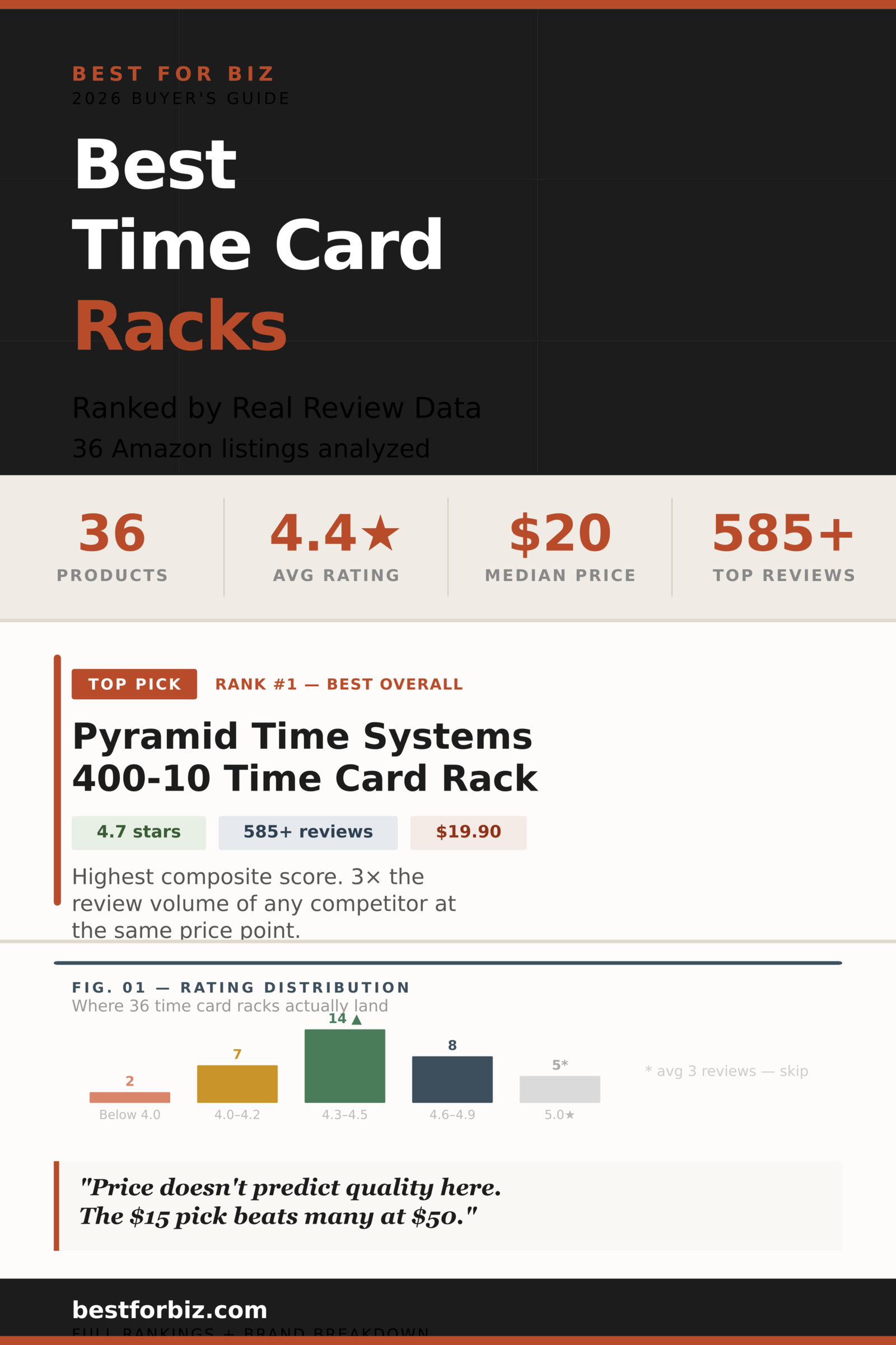
The overall average rating is 4.44 stars, which sounds reassuring until you look at the distribution. More than half the products rated 5.0 stars in this dataset have three reviews or fewer, which is statistically meaningless. When you filter to products with 50 or more reviews, the picture is cleaner and more useful. The chart below shows the full distribution across all 36 products, grouped by rating tier.
N=36 rated listings, de-duplicated. Data collected May 2026.
The 4.3–4.5 range is where the real market lives. Fourteen of the 36 products land there, and these are overwhelmingly the products with meaningful review counts. This is a healthy concentration: it suggests buyers are broadly satisfied with what they receive, and that the category doesn’t have a major quality problem at the low end. The two below-4.0 ratings are outliers, not a trend.
The five 5.0-star products are worth a separate note. Every single one in this dataset has four or fewer reviews. A product with one five-star review is indistinguishable from a product whose sole buyer was the seller’s friend. The chart marks these with an asterisk, and the analysis below uses composite scoring to account for review volume alongside rating.
Does Spending More Get You a Better Time Card Rack?
Short answer: not really. The average rating across all four price tiers in this dataset spans just 0.06 stars, from 4.40 at the premium end to 4.46 in the $20–$30 range. That is not a meaningful difference, and it reflects a category where the underlying product is simple enough that price doesn’t translate into meaningful quality gains for most buyers.
Scale starts at 4.2 to show tier differences clearly. N=36. Under $20 and $20–$30 tiers have sufficient sample sizes for meaningful comparison; $30–$50 has only 2 products.
The $20–$30 tier edges out the others at 4.46 stars, but with only 0.06 stars separating the best tier from the worst, this should not drive your purchase decision. What the price tiers do reveal is a meaningful volume gap. The under-$20 segment has 19 products and an average of 85 reviews per product, making it by far the most validated tier in this dataset. The $30–$50 segment has two products with an average of 148 reviews each, but that small sample makes the comparison less reliable.
The practical implication: set your budget at whatever your workplace needs dictate (pocket count, materials, brand compatibility) rather than assuming higher price equals higher quality. For most small businesses, the under-$20 and $20–$30 tiers contain the most data-backed options in the entire category.
Paper Time Card Racks vs. Badge Racks: Which Type Do You Need?
Two distinct product types appear in this dataset, and buying the wrong one is an easy mistake if you’re not familiar with the distinction. Standard time card racks are designed to hold traditional paper punch cards used with mechanical or digital time clocks. Badge racks (sometimes called swipe card racks or proximity card racks) are designed to hold thicker, rigid proximity cards or employee ID badges used with electronic RFID or magnetic stripe attendance systems. The slot dimensions and depth differ, and the two are not interchangeable.
The market is heavily weighted toward standard paper card racks. Of the 36 products analyzed, 31 are traditional racks and 5 are badge racks. Badge racks are represented primarily by the Pyramid 500 series and Japard’s lineup. If your business runs a biometric or keycard system, the badge racks are worth a specific look. If you run a punch clock, stick to the standard rack category.
Classification based on product title and description. N=36 de-duplicated, rated listings.
This split matters for the rankings below. The composite score rankings treat both types together because the buying decision criteria (quality, value, review volume) are identical regardless of card type. Where a product is a badge rack specifically, it is labeled as such in the product card so you can filter accordingly.
The Best Time Card Racks on Amazon, Ranked
Rankings use a composite score that weights rating alongside review volume using a logarithmic scale. A product with 4.4 stars and 273 reviews outscores one with 4.9 stars and 8 reviews because review volume is evidence, not just a number. All rankings are based on organic listings only.
Ranked by Rating + Review Volume
Which Brands Make the Best Time Card Racks?
Six brands appear two or more times in this dataset, which gives enough data to compare their market presence and performance. The table below shows each brand’s product count, average rating, combined review total, and average price across their listings.
| Brand | Products | Avg Rating | Total Reviews | Avg Price | Take |
|---|---|---|---|---|---|
| Pyramid Time Systems | 5 | ★ 4.56 | 1,200+ | $26.69 | Clear market leader. Highest average rating among multi-product brands and the most total reviews by a wide margin. |
| uPunch | 3 | ★ 4.30 | 400+ | $19.28 | Solid budget brand with legitimate review volume. The HNTCR10 is the standout; the other SKUs are acceptable but less differentiated. |
| Flexzion | 4 | ★ 4.38 | 240+ | $20.74 | Broad SKU lineup covering multiple slot counts with consistent mid-range ratings. Good for buyers who need a specific pocket configuration. |
| Lathem | 2 | ★ 4.45 | 99+ | $36.72 | Premium-priced with strong brand heritage. Best choice if you’re already invested in Lathem time clock hardware. |
| Acroprint | 2 | ★ 4.25 | 80+ | $24.29 | Adequate ratings but no standout product. Acceptable as a secondary option if Pyramid or uPunch are out of stock. |
| Japard | 2 | ★ 4.35 | 15+ | $19.24 | Very early review count for both listings. Promising price point, but insufficient data to recommend with confidence at this stage. |
Pyramid Time Systems dominates this category in a way that few brands dominate any category. Their five products account for more than 1,200 of the roughly 1,900 total reviews in the dataset, and their average rating of 4.56 stars is the highest of any multi-product brand. They span both the standard punch card and badge rack segments. If you have no specific brand requirement, the data points toward Pyramid by a significant margin.
uPunch and Flexzion occupy a reliable mid-tier. uPunch’s average price of $19.28 is the lowest among established brands, and their review volume is genuine. Flexzion’s strength is SKU variety: they have models ranging from 5-pocket to 24-pocket configurations, which is useful when you need a specific size that Pyramid doesn’t stock in your preferred format.
Acroprint has been in the time clock business for decades, but their rack offerings in this dataset underperform relative to their brand reputation. Their two products rate 4.25 stars combined, which is the lowest multi-product average in the table. If you’re already an Acroprint clock user, the compatibility may justify the choice. Otherwise, there are better-reviewed alternatives at similar prices.
How to Choose the Right Time Card Rack for Your Business
The decision comes down to a few practical questions that no amount of star ratings can answer for you.
This is the first question and it determines your product type. Punch clocks use paper time cards that fit standard racks. RFID and keycard systems use rigid proximity cards that require badge racks with deeper, wider slots. Buying a standard rack for a badge system or vice versa will leave you with a product that doesn’t function as intended.
Pocket count matters. Most racks in this dataset range from 5 to 50 pockets. For teams under 12, a 10 or 12-slot rack handles the load and stays compact. For teams up to 25, a 24 or 25-pocket model is the standard choice. Larger teams should look at 40-pocket or expandable racks like the Pyramid 500-4 (40 pockets, 4.5 stars) or models with double-row configurations.
Some time clocks use non-standard card sizes. Lathem’s classic punch clocks use 7-inch cards, which require racks explicitly designed for that size. Amano clocks have their own sizing conventions. If you’re replacing a rack for an existing clock system, check your card dimensions before buying rather than assuming a standard rack will fit.
Most racks in this category are plastic, and the review data does not suggest metal racks outperform plastic ones on customer satisfaction. That said, metal racks are more appropriate for high-traffic industrial settings, warehouses, or environments with frequent handling. If durability in rough conditions is a concern, look specifically for steel construction rather than assuming any rack labeled “heavy duty” delivers that.
Several racks in this dataset are expandable, meaning you can add sections as your team grows. The Pyramid 400-X and Flexzion’s expandable models are designed for this. If you’re outfitting a growing business, expandability saves you from replacing the whole rack when you add five employees.
Our Verdict
The time card rack category is narrower than it looks. Once you remove the zero-review listings, the near-duplicates, and the five-star products with single-digit review counts, the decision tree simplifies considerably. Pyramid Time Systems has earned its position through consistent performance across multiple SKUs and genuine review volume. Their 400-10 is the top choice for most buyers, and their 500 series is the top choice for badge systems.
The one insight worth carrying out of this analysis: price does not predict quality here. The under-$20 tier is as well-rated as any other. Spend to the level your capacity needs require, but don’t pay a premium hoping for better construction. The data does not support that trade.
Related business guides: upgrade your workspace with these top ergonomic chairs guide and best rolling whiteboards for a fresh start guide for more practical business equipment advice.